Preparing the case: chronology of an attempted employment fraud
This timeline reconstructs, in anonymized form, the evidentiary sequence of a real employment case involving a small company with four employees. An employee said that he wanted to leave his job to pursue a master’s degree, but during a conversation with the company he learned that resigning voluntarily would not entitle him to unemployment benefits. From that point on, he changed his original plans for leaving the company.
Several days later, an administrative error by the company’s employment adviser resulted in the employee’s termination being reported with the wrong date. According to the company’s case, the employee attempted to exploit that error by presenting the situation as an unfair dismissal, claiming compensation and fraudulently obtaining unemployment benefits.
Names, dates and identifying references have been changed, and the accompanying screenshots are anonymized recreations of the documents and communications used to prepare the defence.
The timeline arranges the facts in the order in which they were presented at trial: the prior context of the employment relationship, communications concerning the employee’s voluntary departure, a recorded conversation about unemployment benefits, the administrative processing of the termination, the adviser’s error, the subsequent correction, access restrictions, communications between the parties, alleged periods of sick leave and the final settlement.
The lawyer based the presentation on this chronological sequence to show what happened, when it happened, what evidence supported each fact and where the genuinely disputed issues lay. The case was won using this reconstruction of events as the central framework of the argument.

Export timeline
Export format
Export all currently filtered vertical timeline events as PNG or PDF.
Background to the employment relationship and prior working arrangements
Before the main events of January 2026, the relationship between Ramón and the company had already developed over a prolonged earlier period. Ramón had completed an internship between January and May 2024 at a small professional services company. The internal assessment of that first experience was positive, and there is no record of any conflict being documented during that phase. After the internship, in September 2024, he was hired for administrative duties within a very small structure made up of Antonio, Carolina, and Ramón himself. In that context, any change in availability or absence had a direct impact on the day-to-day organization of work.
Throughout the employment relationship, communication remained frequent and close. Ramón shared personal and family circumstances with Antonio and Carolina; these are included here only in general terms, without unnecessary intimate details. He had also described a previous external employment experience in which, according to his account, he continued working until the end of the contract despite demanding circumstances. That background is included solely as context for what he himself had said before the later dispute arose.
Ordinary day-to-day working relations included shared meals and team routines, regular conversations, and an informal atmosphere. Other people present in the office could corroborate that general dynamic. Up to the beginning of January 2026, the documented sequence does not show a history of sustained confrontation, but rather a relationship combining trust, direct communication, and practical flexibility.
In the preceding months, the company had adjusted working hours and considered allowing remote work on certain days to make Ramón's commute easier. That flexibility continued even though the company believed that his remote performance was not equivalent to his in-office performance. The issue would arise again later when studies, working hours, continuity of employment, and a possible reorganization of the position were discussed.
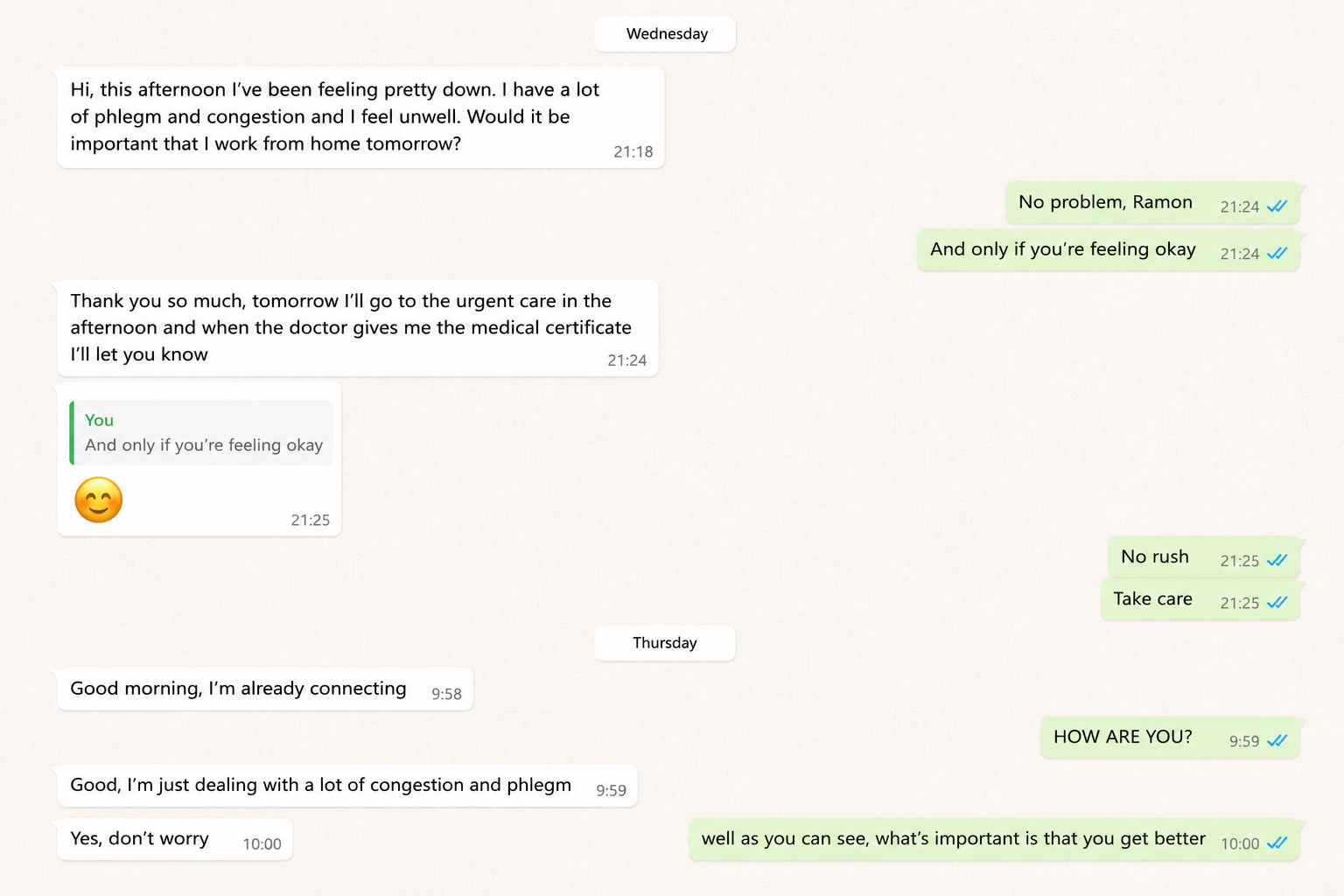
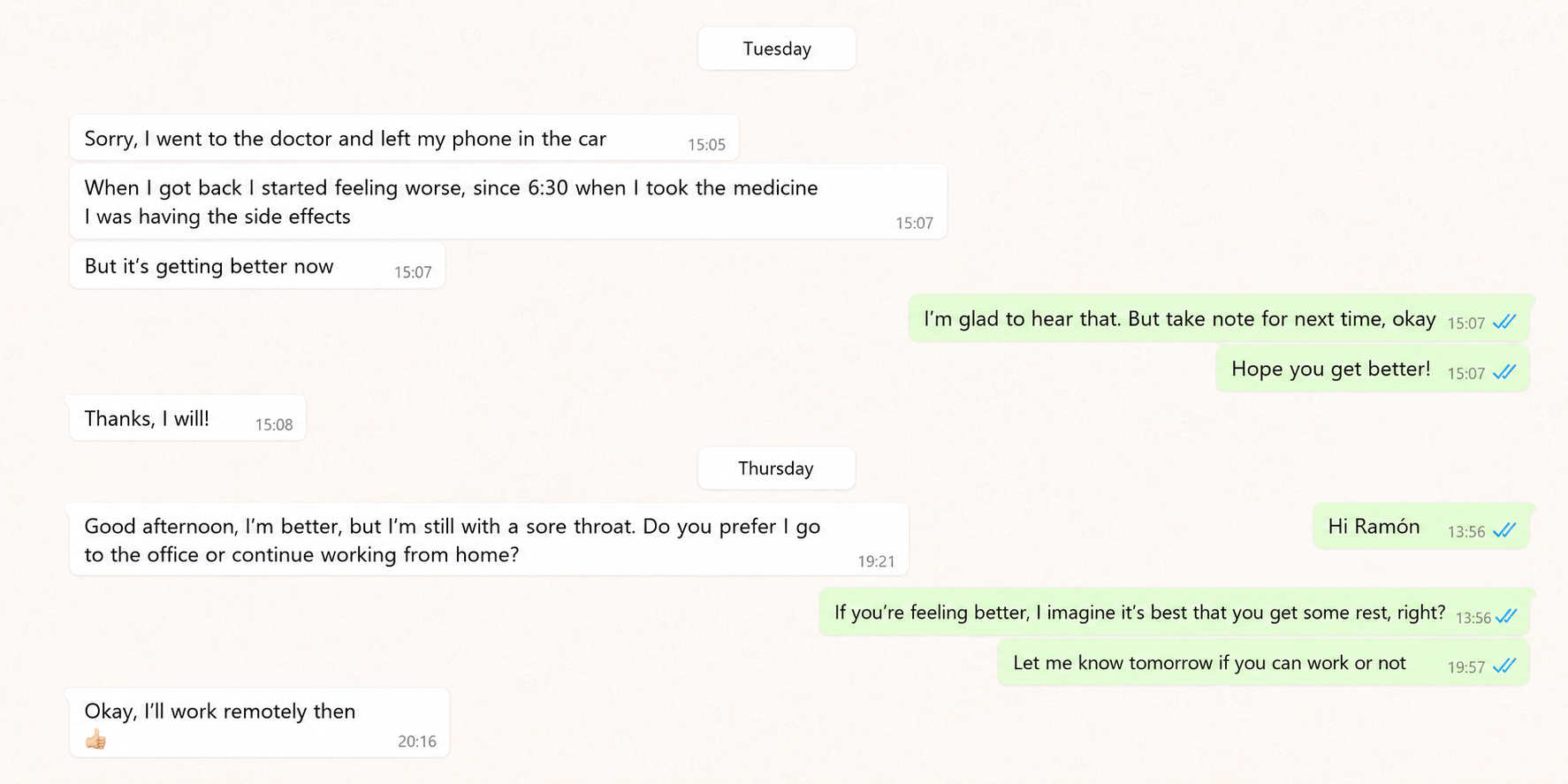
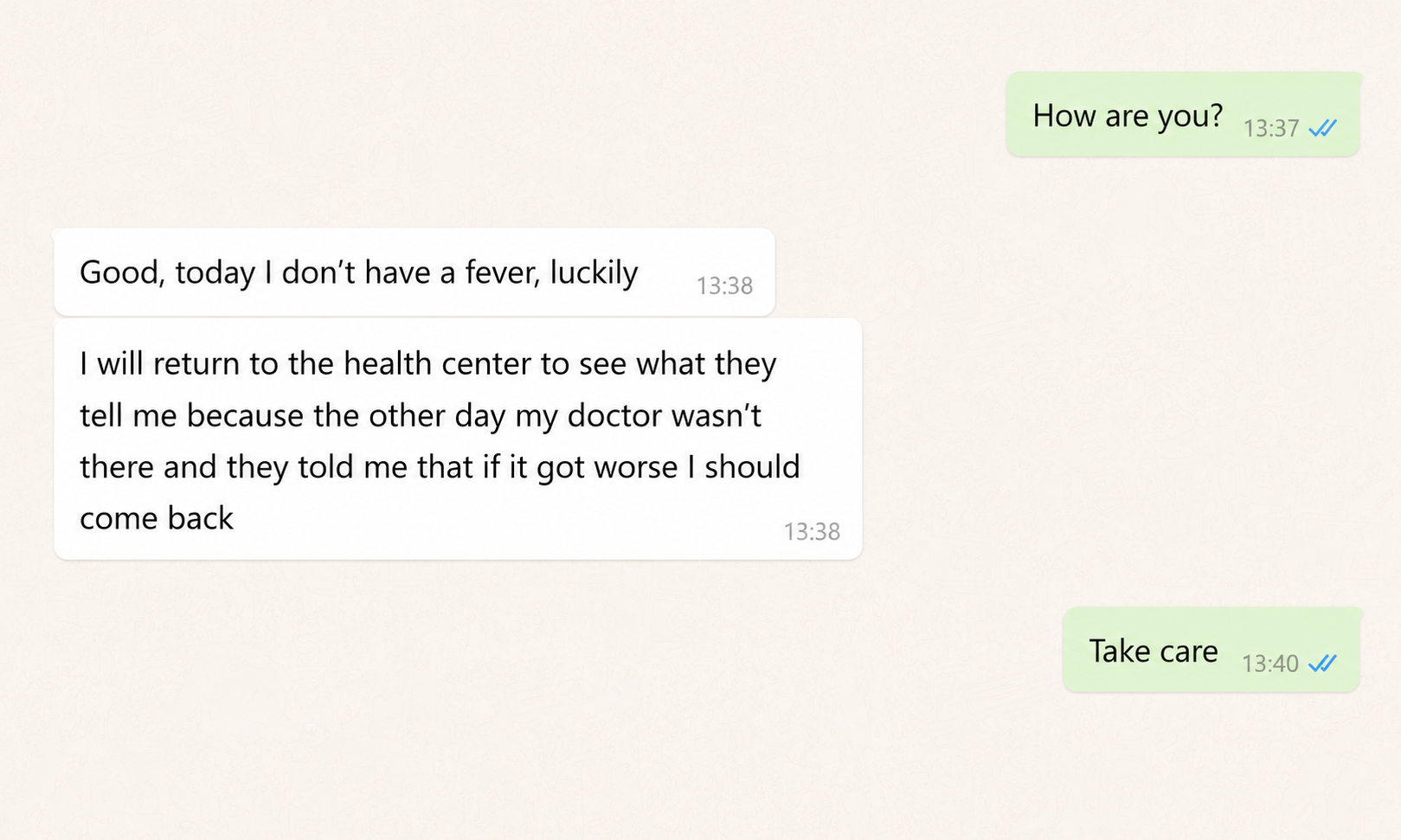
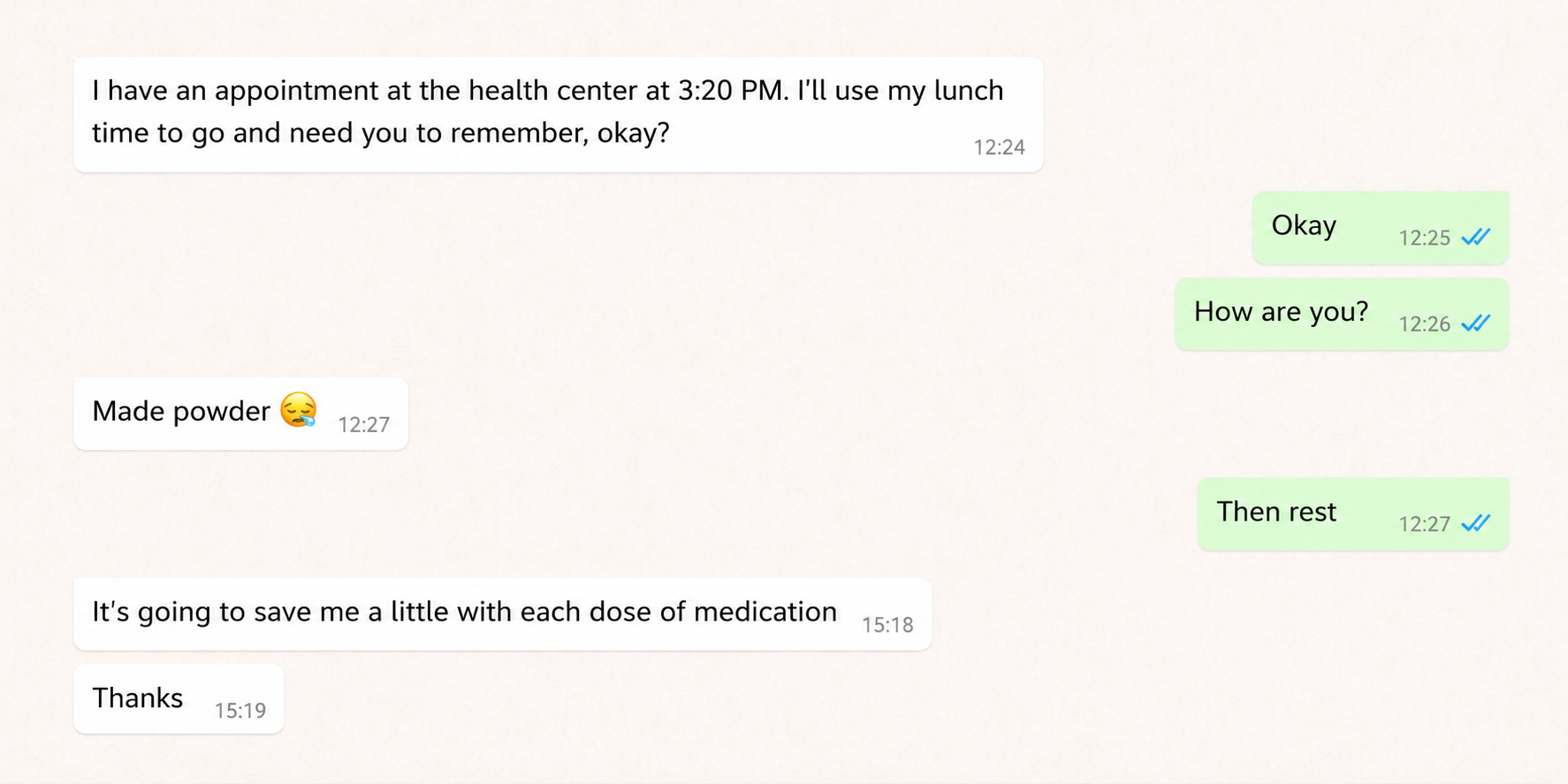
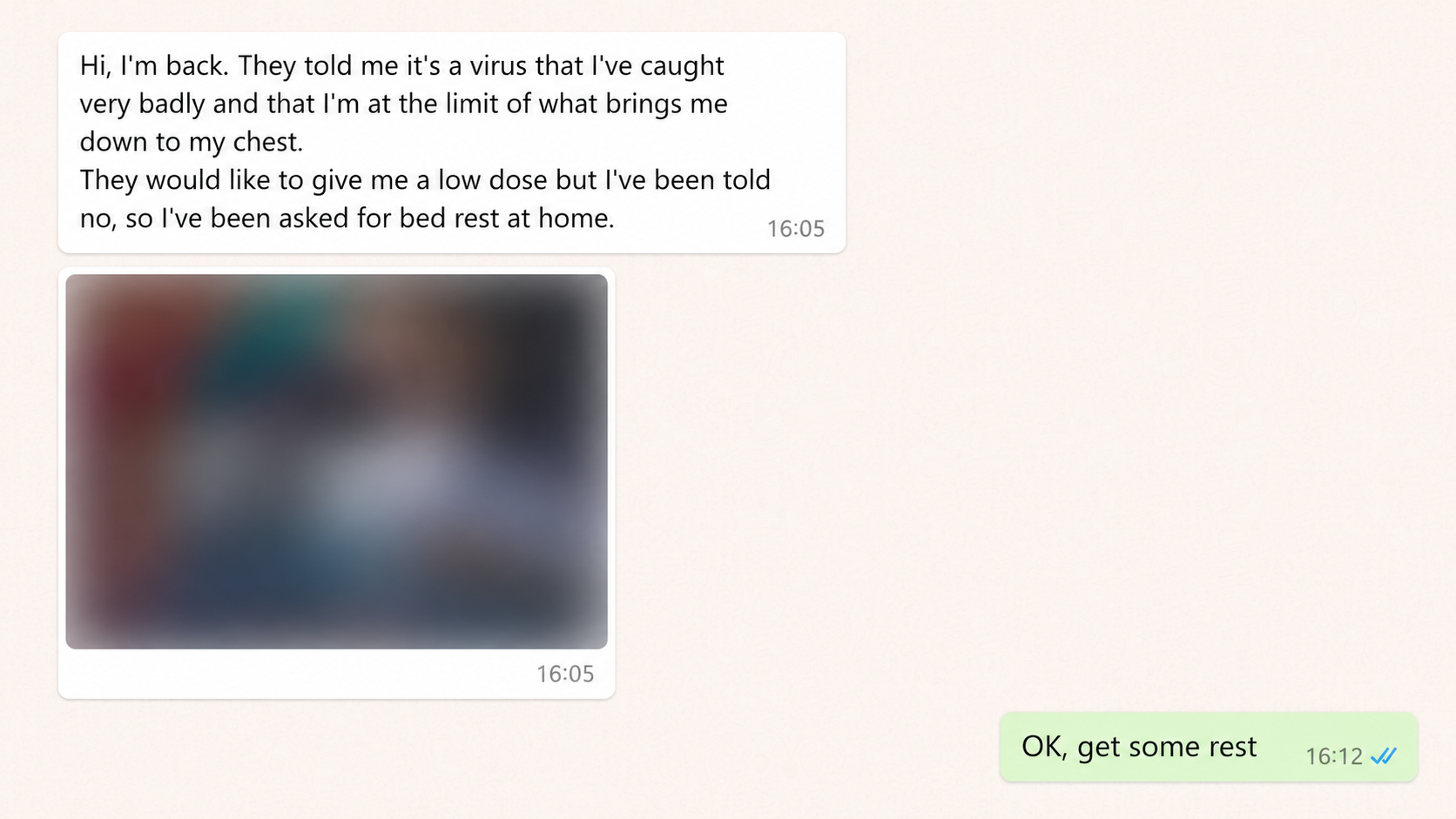
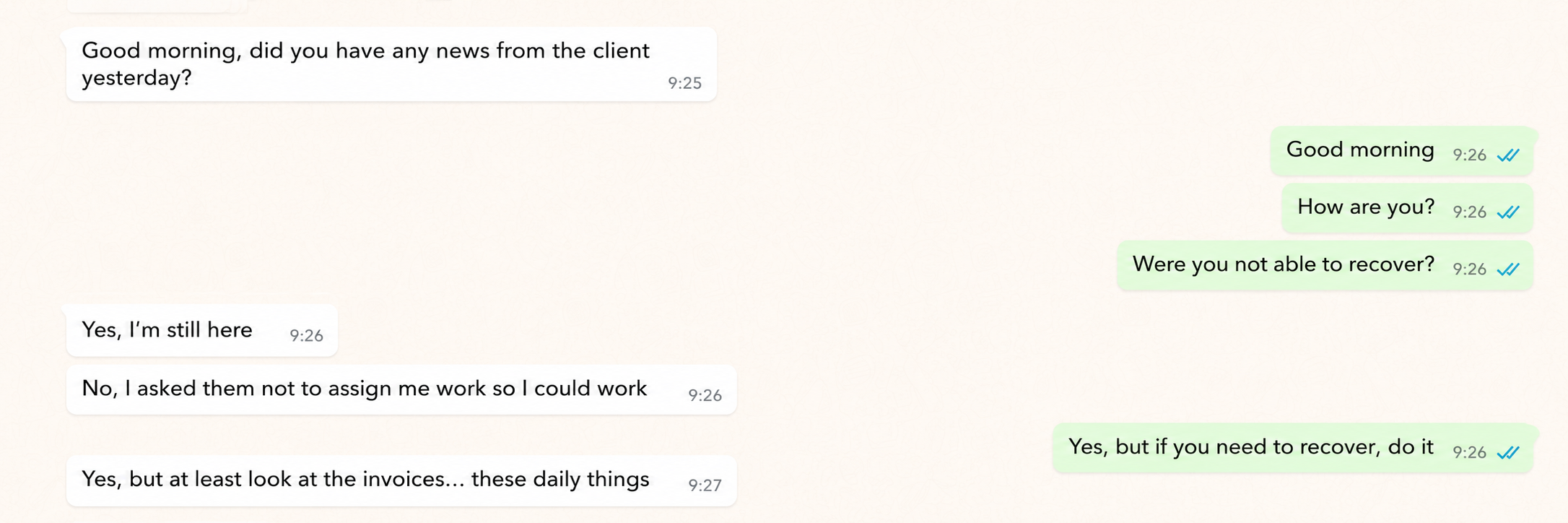
There are also earlier communications concerning illness, medical appointments, and rest. In November and December 2025, Ramón reported on several occasions that he felt unwell, had symptoms, needed to see a doctor, or had been advised to rest at home. The company responded by allowing remote work when he requested it, asking about his recovery, telling him to get better, and accepting that he rest when he was not fit to work. In one of those communications, Ramón even said that he intended to attend despite feeling unwell, and the company told him not to try if he was not well enough.
Shortly before the main events, the company also gave Ramón a mobile phone after noticing that his own was damaged. Taken together, this background establishes the prior relationship: employment in a small company, fluid personal communication, flexible measures for ordinary incidents, and several WhatsApp screenshots documenting how health, rest, and work availability had previously been handled.

First communication about studies and a possible reduction in working hours
Event type: initial communication.
Relevant fact: Ramón tells Carolina that he has started a training programme that he has already paid for and may be unable to combine with work. He says that he will review the schedule and raise the possibility of working half-time.
Evidentiary relevance: it places the origin of his departure in a training-related decision communicated by Ramón before the administrative dispute.
Associated evidence: Carolina's testimony and her subsequent internal communication with Antonio.
Internal assessment of a part-time alternative
Event type: internal assessment.
Relevant fact: Antonio and Carolina assess the situation communicated by Ramón and agree to offer him a part-time alternative.
Evidentiary relevance: it shows that the company considered a solution that would preserve the employment relationship before receiving the voluntary resignation.
Associated evidence: testimony from Antonio and Carolina.
Antonio's absence from the office
Event type: chronological context.
Relevant fact: Antonio does not attend the office that day because of a family circumstance. The direct conversation with Ramón is postponed until the following day.
Evidentiary relevance: it explains why the main meeting takes place on Day 6 rather than immediately after Carolina relayed the initial communication.
Associated evidence: internal diary and Antonio's testimony.
Meeting, unemployment benefits, and formalization of the voluntary resignation
Antonio meets with Ramón to discuss the information Carolina had passed on about his studies. Ramón confirms that he has paid for the training programme and intends to focus on that new stage. The company proposes reorganizing his working hours as an alternative to leaving, but Ramón rejects the option because he believes he needs to devote his time to the course.
During the same conversation, Antonio asks how Ramón plans to support himself financially after leaving the position. Ramón says that he expected to receive unemployment benefits. Antonio warns him that a voluntary resignation does not entitle him to unemployment benefits and suggests checking this on the work computer. At that point, Antonio starts recording the conversation to retain a record of what was said.
The check changes Ramón's initial plan. After understanding that he will not be entitled to unemployment benefits, he says that he will have to find another option. Remote work is also discussed, although he himself acknowledges that his remote performance is not equivalent to his in-office performance. The conversation establishes the shift from the initial idea of working until the end of the month to the later decision to finish as soon as possible within the minimum notice period.
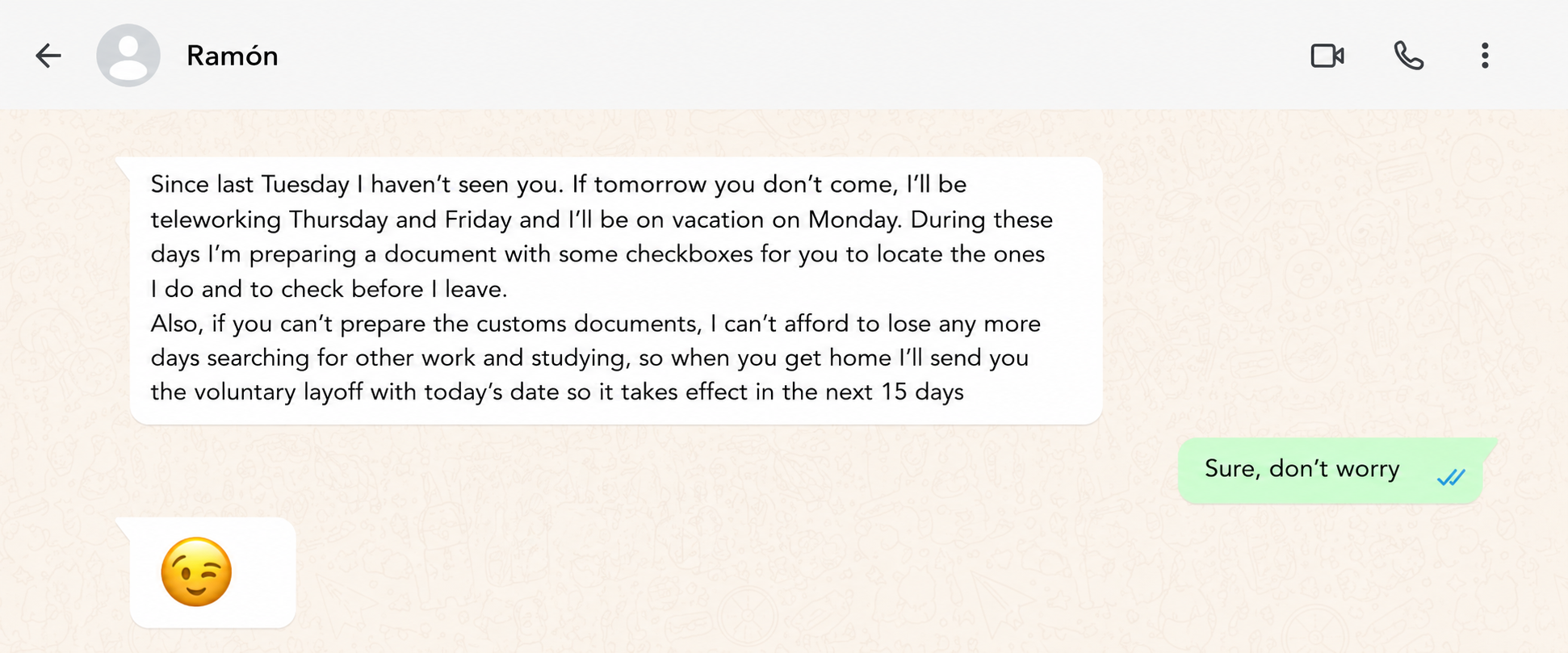
After the meeting, Ramón sends a WhatsApp message setting out the following days: an absence related to company commitments, requested remote work, previously requested leave, and preparation of a handover document for Carolina. In that message, he states that, having learned that he will not receive unemployment benefits, he will not work until the end of the month and will finish as soon as possible within the minimum notice period.
That same day, Ramón emails his voluntary resignation, with the planned termination date set for Day 21 of the fictional chronology. Antonio tells Carolina that he recorded part of the conversation beginning when Ramón checked the consequences of voluntary resignation. The documents collected that day preserve the full sequence: the decision based on studies, rejection of an alternative working schedule, the check regarding unemployment benefits, the change of plan, the WhatsApp message about leaving, and formalization of the resignation.
Forwarding the voluntary resignation to the advisory firm
Event type: processing.
Relevant fact: Antonio forwards the voluntary resignation to César so that it can be processed in accordance with the document sent by Ramón.
Evidentiary relevance: it shows that the company sent the resignation to the advisory firm on the terms communicated by the employee.
Associated evidence: email forwarding the resignation to the advisory firm.
Notice regarding the final settlement and direct conversation with César
Event type: management communication.
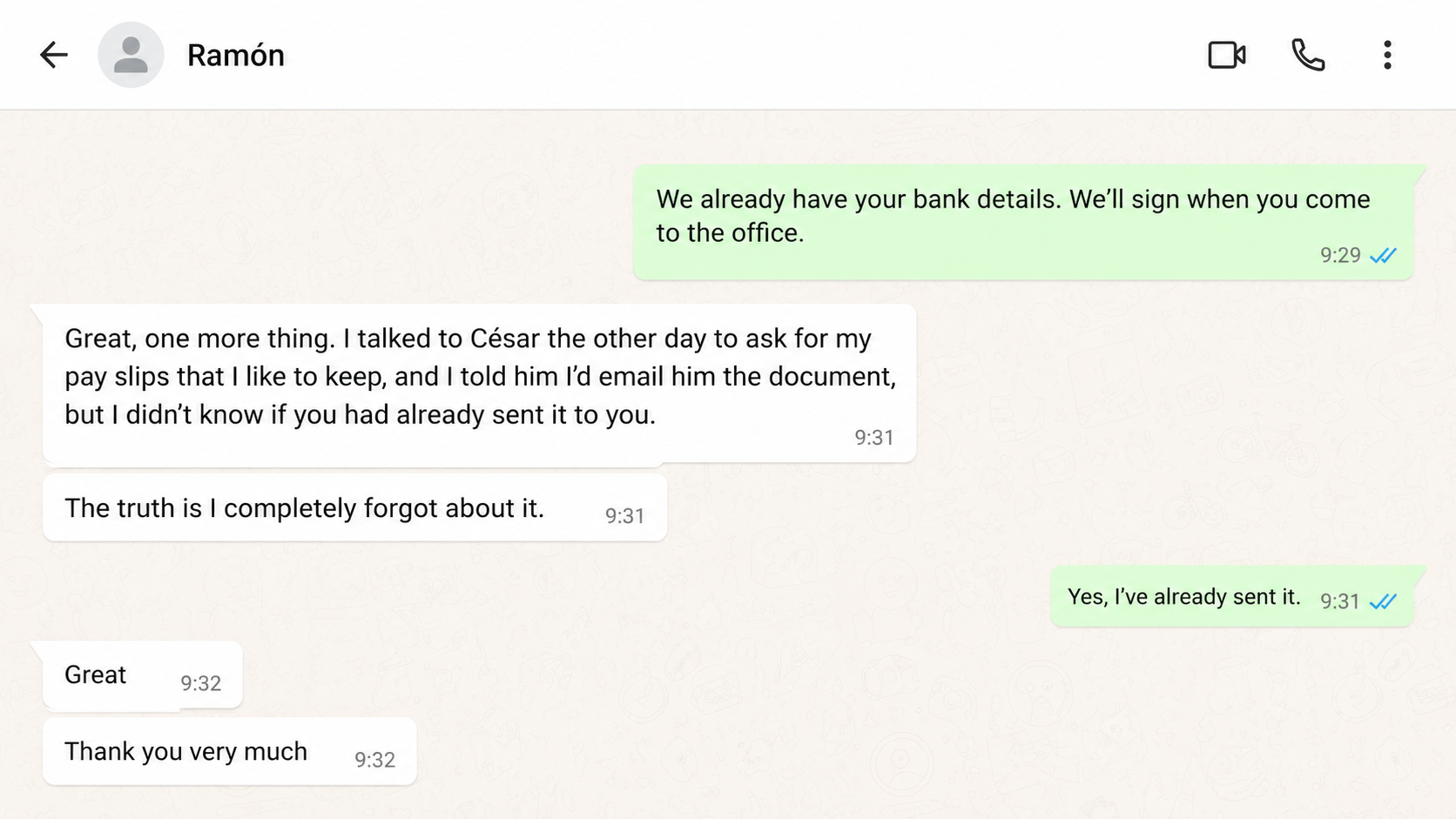
Relevant fact: early on Day 9, Antonio receives an email from César containing the final settlement. Before reviewing it, he informs Ramón that the documents are being prepared in advance. Ramón then says that he had called César directly to ask for payslips and tell him that he was leaving.
Evidentiary relevance: it introduces the direct communication between Ramón and César, without going through Antonio, which later becomes relevant in explaining the misunderstanding over the effective date.
Associated evidence: WhatsApp screenshot.
Disputed point: exactly what was communicated during the direct conversation between Ramón and César.
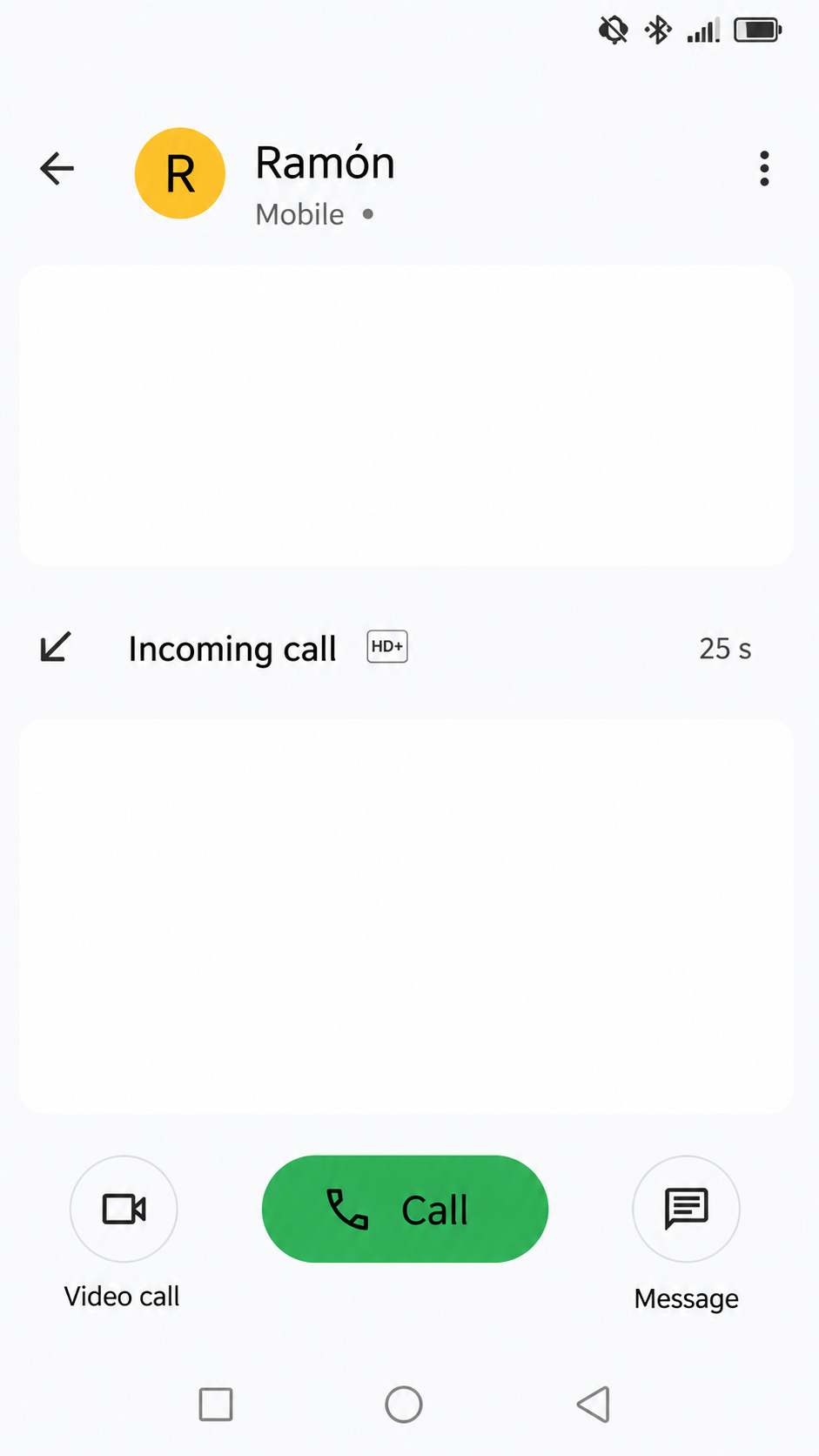
Call from Ramón regarding an administrative notification
Event type: call.
Relevant fact: Ramón calls Antonio and says that he has received an administrative notification showing an employment deregistration effective from a date that does not match his voluntary resignation. Antonio replies that it must be an error and tells him to raise it with César so that it can be corrected. The call lasts approximately 25 seconds.
Evidentiary relevance: it establishes the first notice of the administrative error and Antonio's immediate reaction, which neither confirms the incorrect deregistration nor presents it as a company decision.
Associated evidence: call log.
Disputed point: whether the notification could reasonably be interpreted as a dismissal or as a processing error.
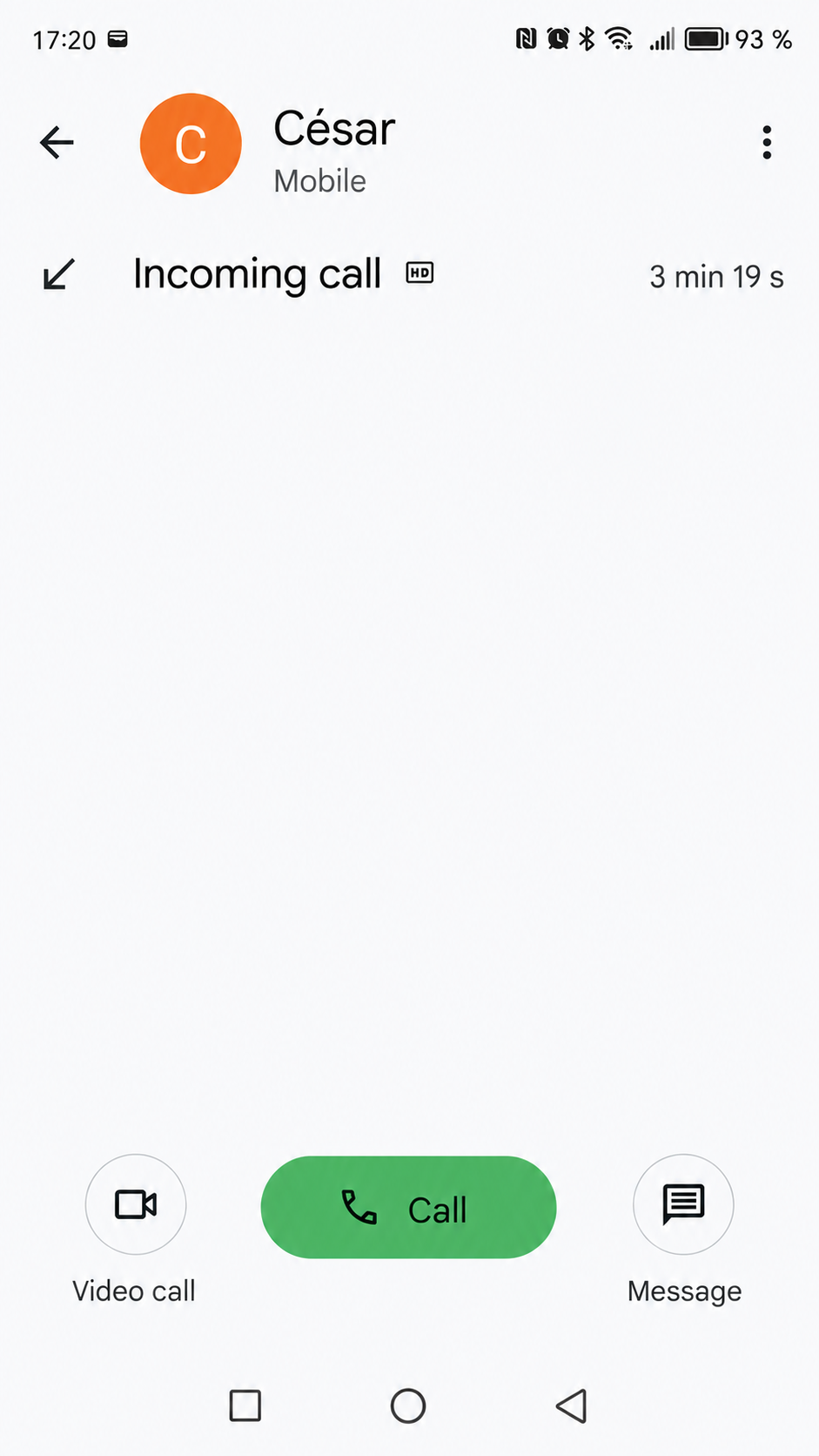
Call from César and explanation of the misunderstanding
Event type: call with the advisory firm.
Relevant fact: César calls Antonio and explains that, after speaking directly with Ramón, he understood that the employment deregistration should take immediate effect. Antonio tells him that this was not what had been agreed, that the resignation had to be processed in accordance with the document submitted, and asks him to correct the situation.
Evidentiary relevance: it identifies the source of the administrative error as a misunderstanding arising from the direct communication between Ramón and César.
Associated evidence: call log.
Disputed point: whether the error resulted from an instruction by the company, an interpretation by the advisory firm, or the prior conversation between Ramón and César.
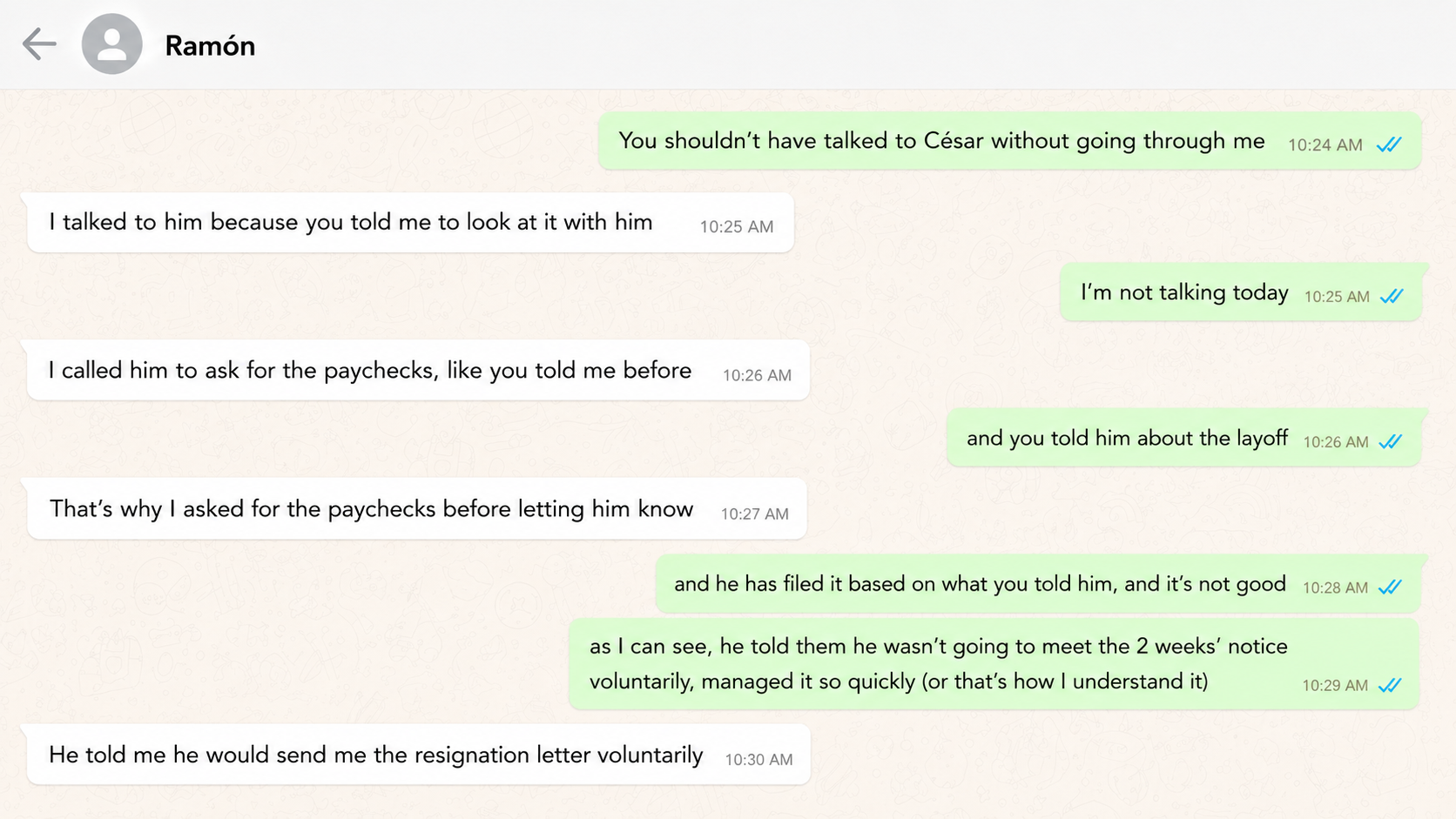
Immediate communication to Ramón about the source of the error
Event type: written communication.
Relevant fact: Antonio immediately tells Ramón that the incorrect deregistration occurred because César understood from their direct conversation that it should be processed with immediate effect. He also says that the misunderstanding would not have occurred if the matter had been channelled through Antonio.
Evidentiary relevance: it shows that the company communicated the source of the error and did not attempt to maintain the incorrect deregistration.
Associated evidence: WhatsApp screenshot.
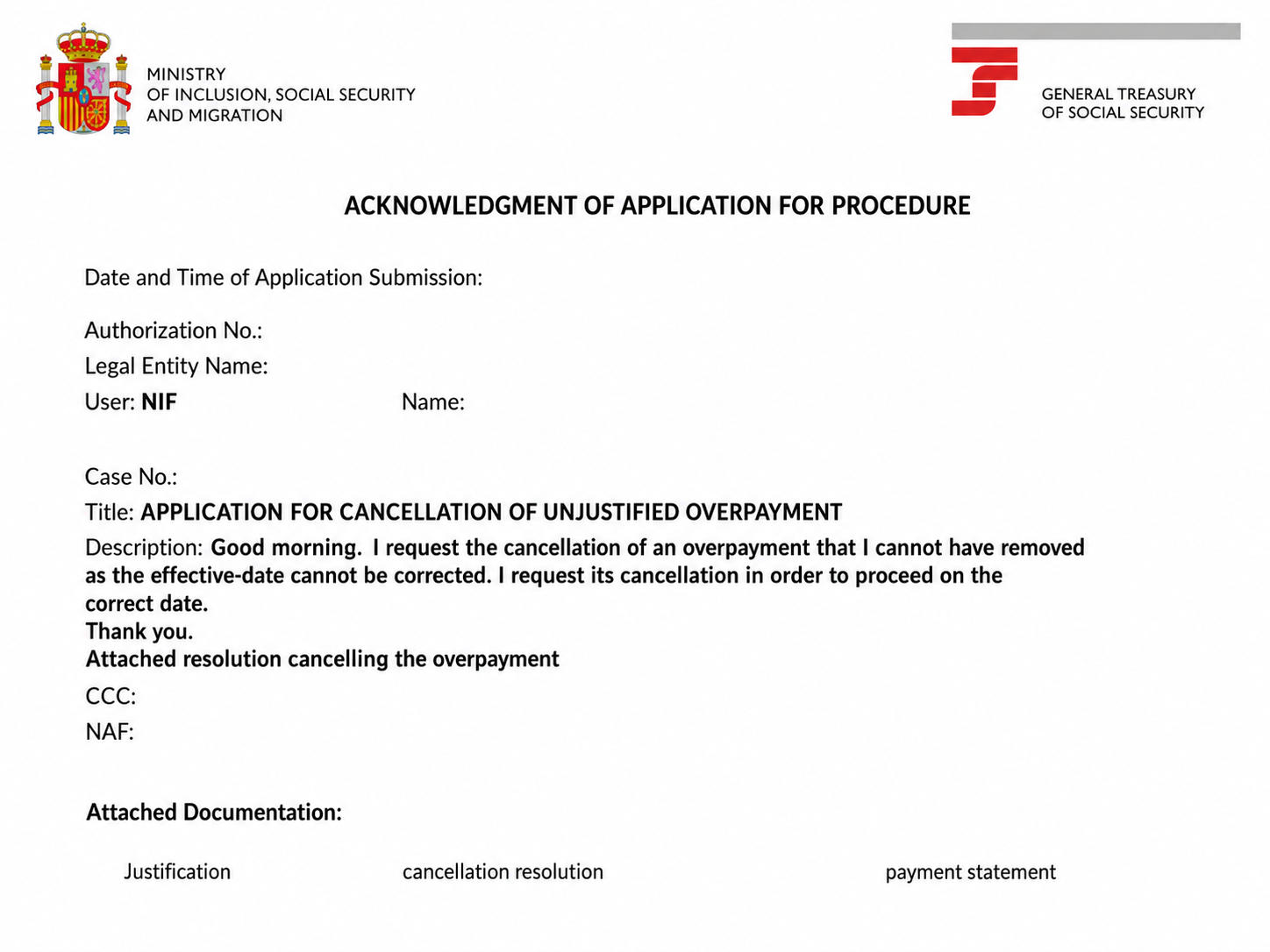
Request to cancel the incorrect deregistration
Event type: administrative procedure.
Relevant fact: a request is submitted to cancel or correct the incorrect deregistration so that it matches the voluntary resignation communicated by Ramón.
Evidentiary relevance: it demonstrates the corrective response by the company and the advisory firm after the error was detected.
Associated evidence: administrative receipt.
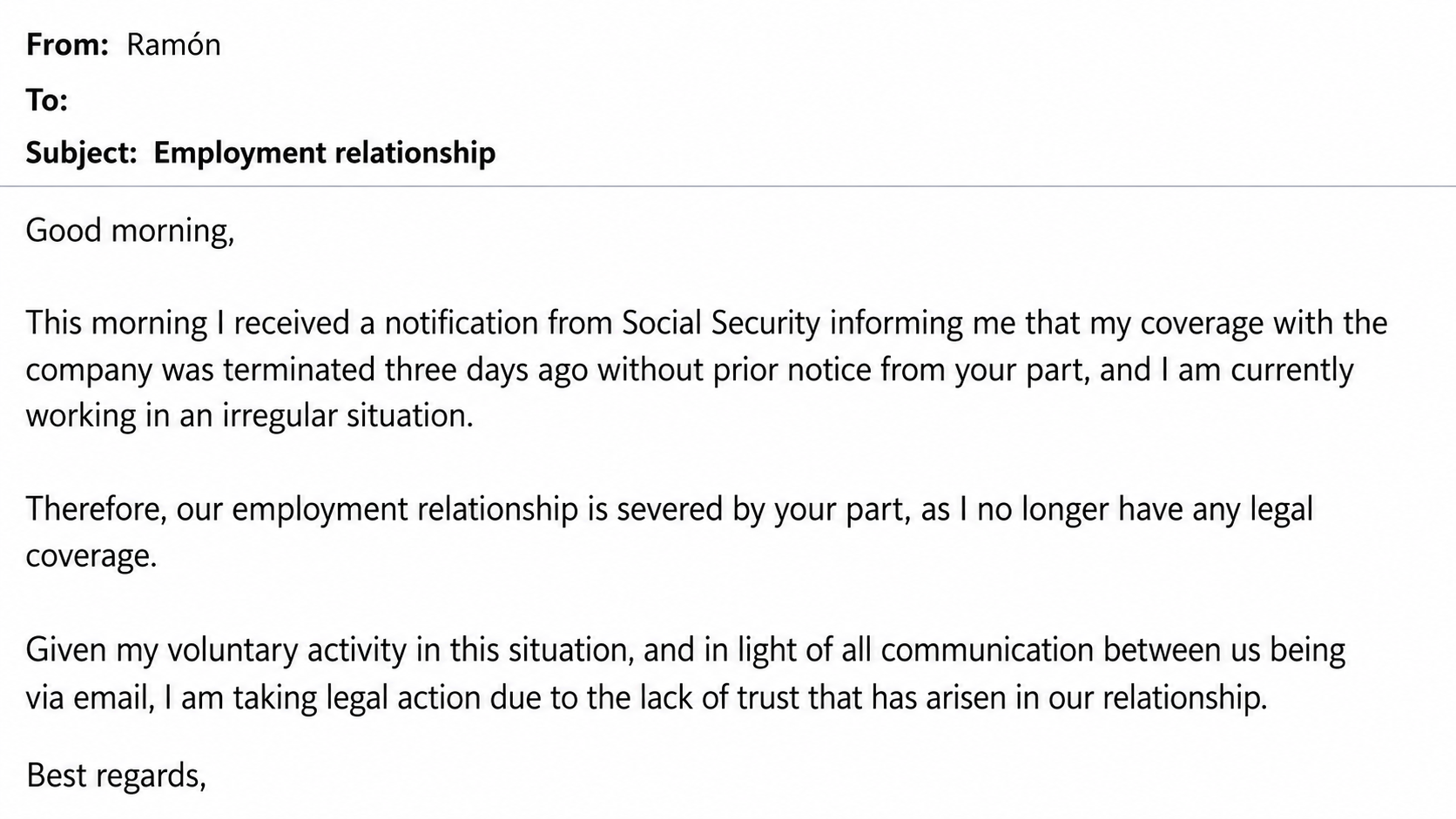
Email from Ramón announcing legal action
Event type: conflict communication.
Relevant fact: Ramón sends an email announcing legal action against the company.
Evidentiary relevance: it marks the formal beginning of a confrontational position after the company had explained that the matter was an error and was being corrected.
Associated evidence: email from Ramón.
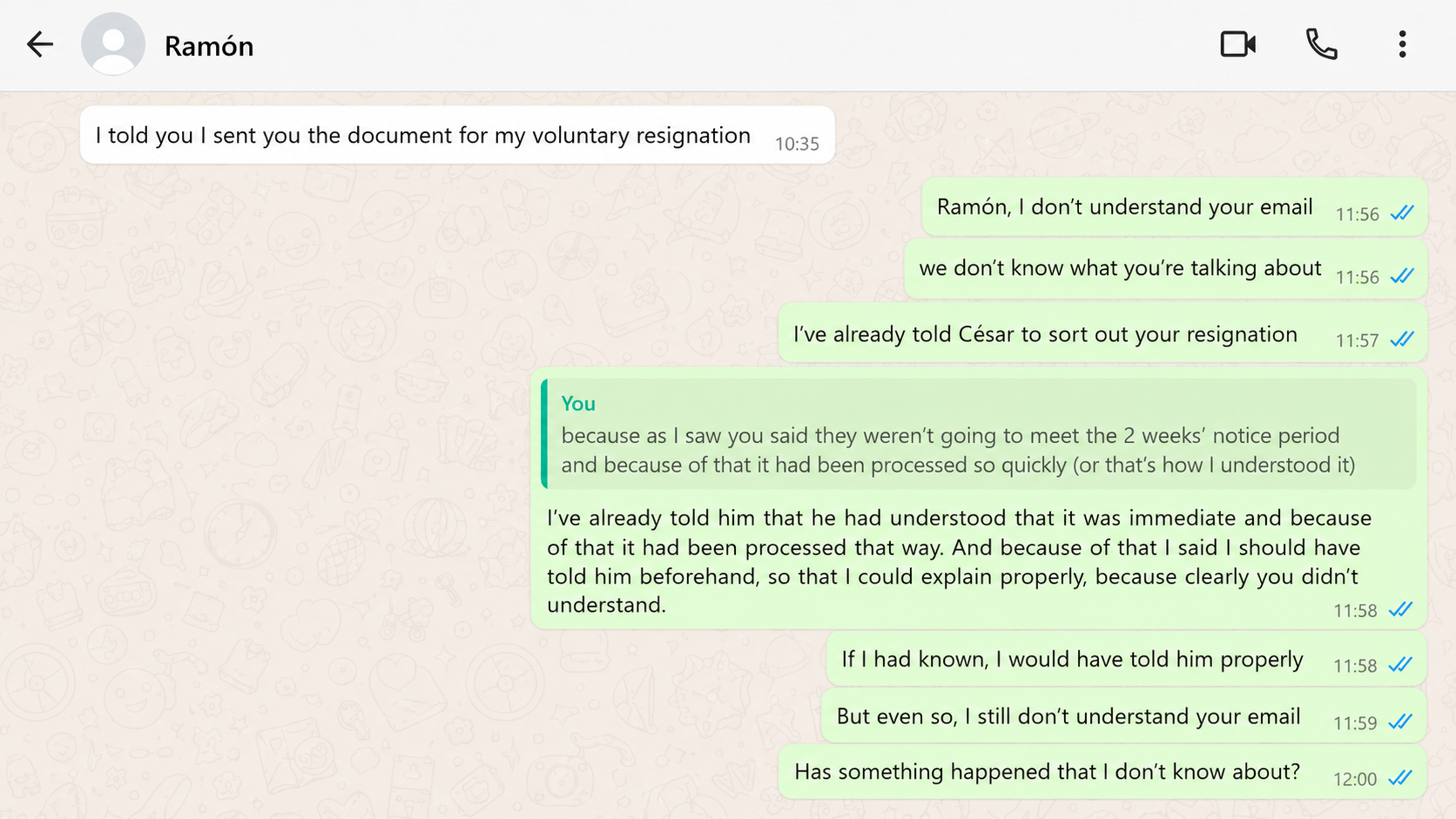
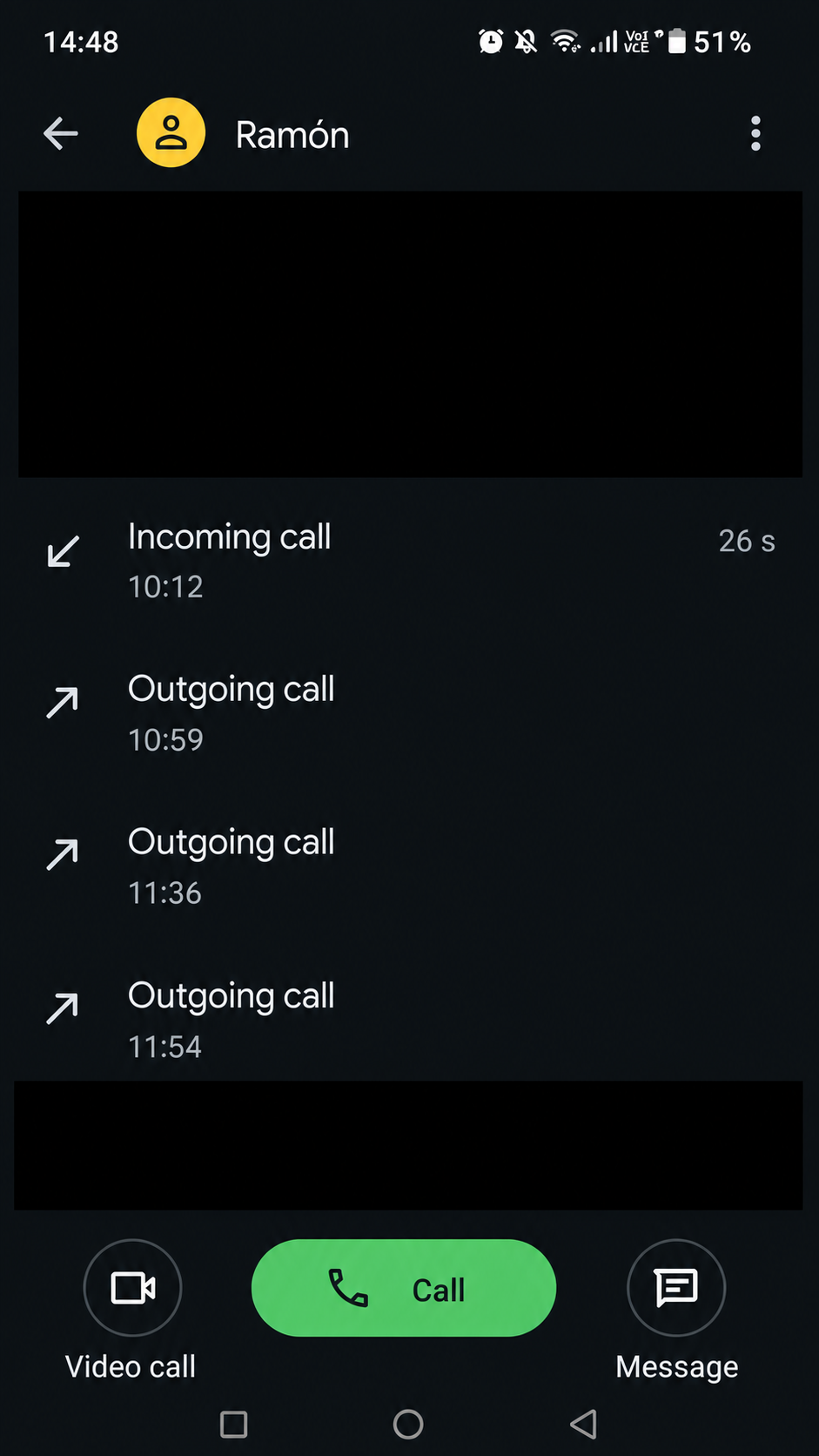
Attempts to make contact after the threatening email
Event type: attempts to make contact.
Relevant fact: after receiving Ramón's email, Antonio tries to contact him by WhatsApp and telephone to clarify what happened, but receives no immediate response.
Evidentiary relevance: it documents the company's attempt to open a direct channel of explanation before the conflict escalates further.
Associated evidence: WhatsApp screenshot and call log.
Ramón claims there was a dismissal and irregular work
Event type: conflict communication.
Relevant fact: Ramón sends another email stating that he considers himself dismissed and that he is being kept working in an irregular situation.
Evidentiary relevance: it records in writing the argument that later structures the dispute: treating the processing error as an alleged decision by the company to terminate the employment relationship.
Associated evidence: email from Ramón.
Disputed point: whether there was a dismissal or whether the only formal termination was the voluntary resignation previously submitted by Ramón.
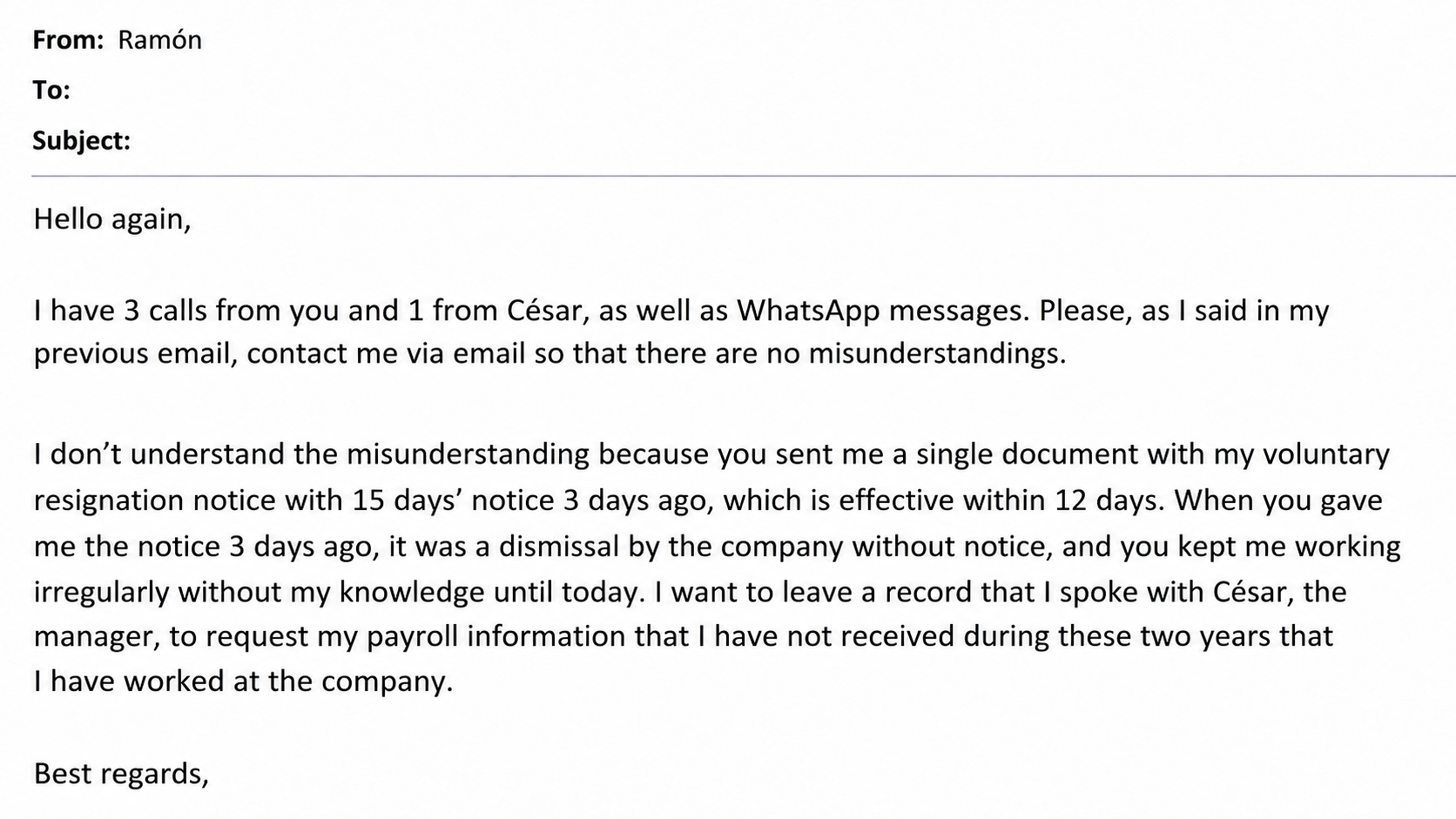
Preventive restriction of access to sensitive data
Event type: preventive measure.
Relevant fact: after receiving the communication in which Ramón claims that he has been dismissed and is working in an irregular situation, the company restricts access to sensitive data and changes remote-access passwords. The history of communications with Ramón is also preserved.
Evidentiary relevance: the measure is taken after the conflict escalates and is presented as a preventive control over corporate information.
Associated evidence: internal record of access changes and download of the WhatsApp conversation history.
Disputed point: whether the access restriction can be interpreted as an organizational measure taken after the conflict or as evidence that the employment relationship had effectively ended.
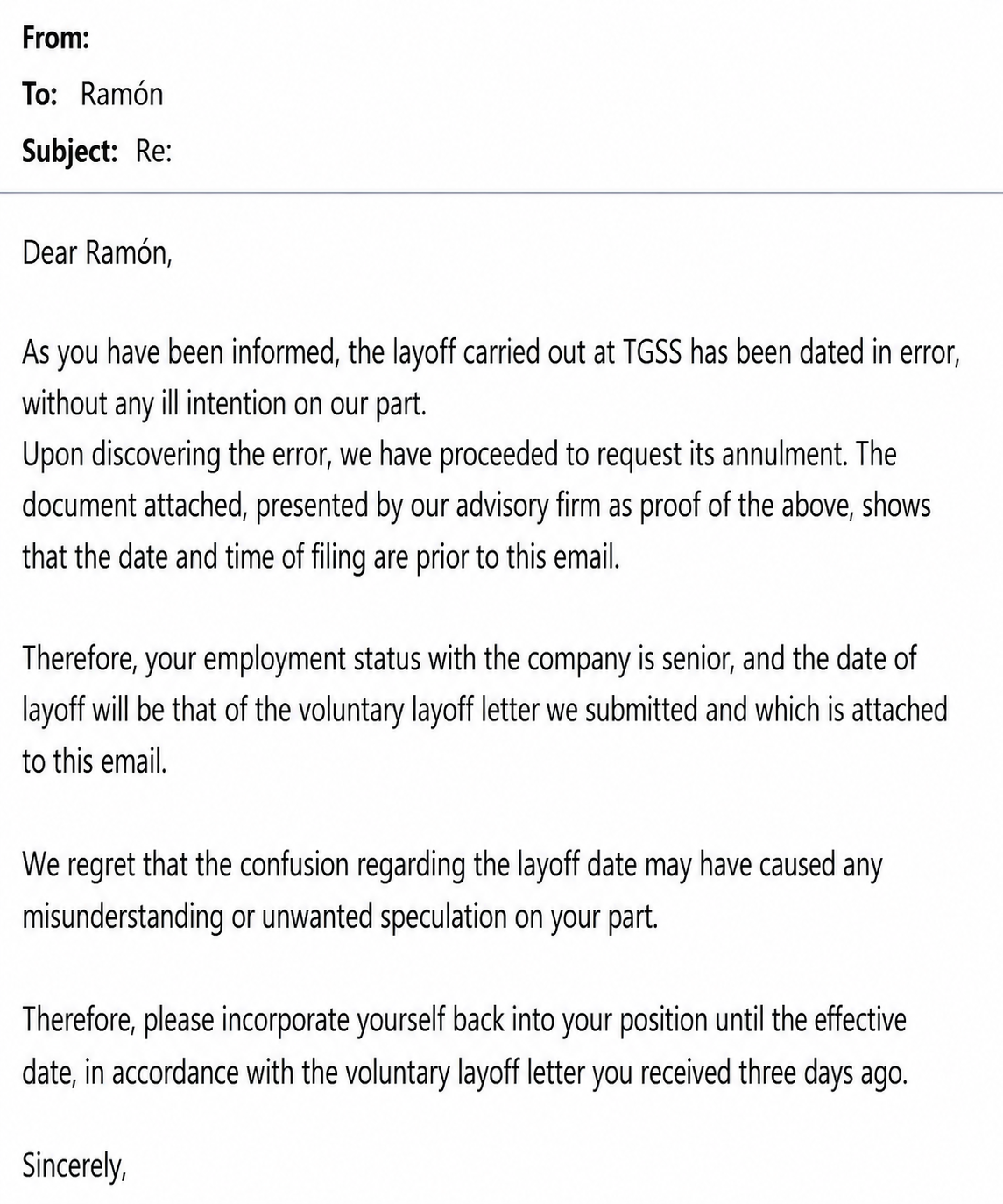
Company response with evidence of correction
Event type: company response.
Relevant fact: Antonio sends Ramón an email, prepared with César's assistance, explaining that the dismissal interpretation is incorrect and attaching the request to correct the erroneous deregistration.
Evidentiary relevance: it shows that the company communicated its position in writing and provided documentary support for the correction.
Associated evidence: email from Antonio and evidence of the correction request.
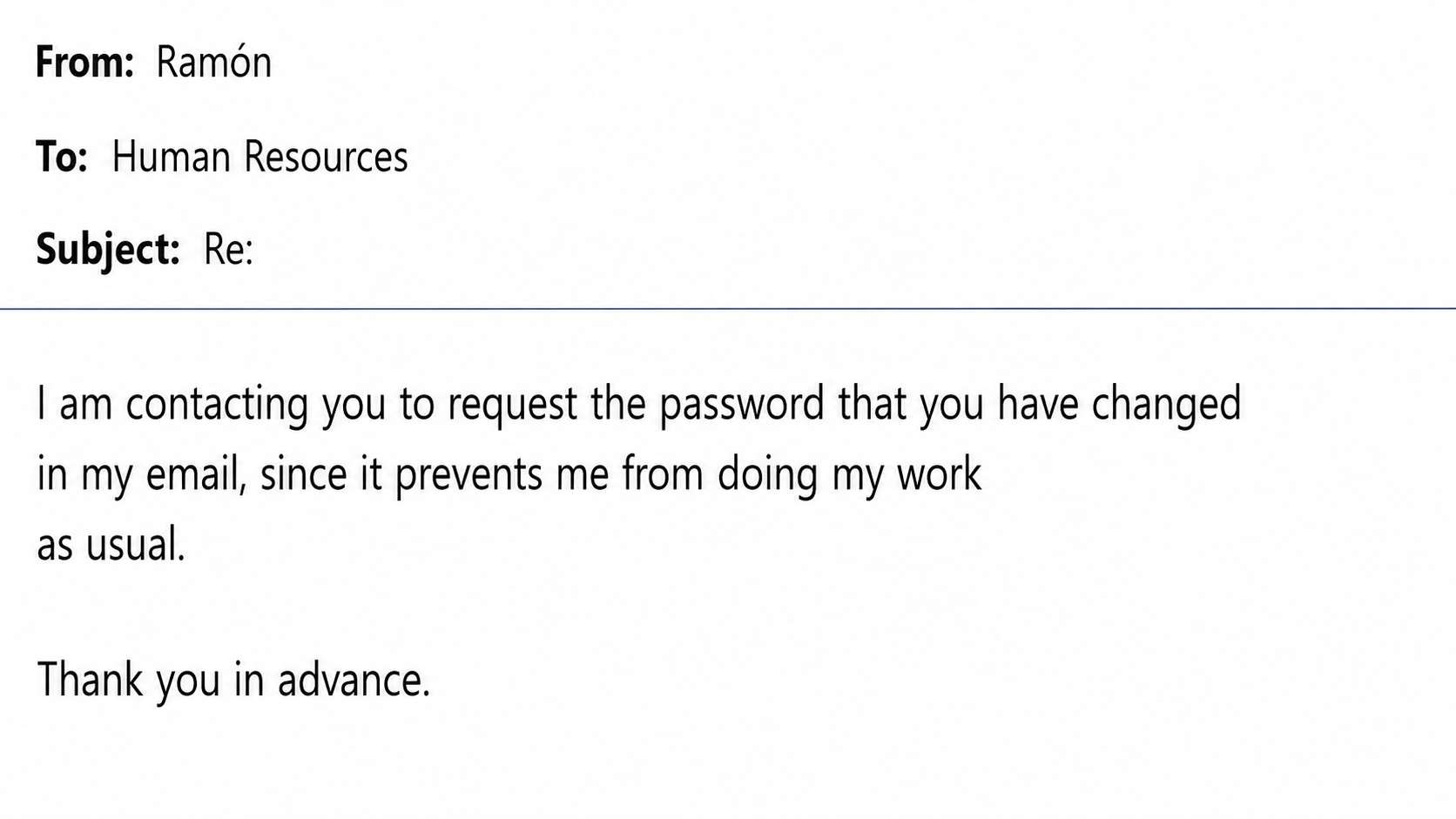
Ramón reports lack of access to email
Event type: written communication.
Relevant fact: Ramón replies that he cannot access his email and that this prevents him from working.
Evidentiary relevance: it links the preventive access restriction to the later allegation that he was unable to perform his work.
Associated evidence: email from Ramón.
Disputed point: whether the lack of access made work impossible or whether it was a reversible measure taken after the conflict escalated.
Access password sent
Event type: company action.
Relevant fact: the company provides the access password following Ramón's communication.
Evidentiary relevance: it shows that the access restriction was not maintained as an absolute impediment to working.
Associated evidence: communication sending the password.
In-person meeting following the administrative dispute
After the conflict escalates, Carolina suggests repositioning an existing security camera in the office to widen the viewing angle in the room. A CCTV notice is displayed at the entrance. The measure is adopted before a sensitive in-person conversation and forms part of the company's internal precautions in the case.
Ramón works normally during the morning. After the interns leave, Antonio asks whether he wants to discuss what happened. Ramón agrees and explains that he felt dismissed when he received the administrative deregistration notification. That explanation places the source of his reaction in the way he interpreted the administrative communication, rather than in any direct instruction from Antonio.
Antonio and Ramón call César on speakerphone to compare the different accounts of the conversation with the advisory firm. Ramón says that he understood he was being dismissed and that César told him not to speak to Antonio. César denies that version. The call concentrates the main dispute over what was said between Ramón and the advisory firm and whether that conversation could have led him to believe that a dismissal existed.
Antonio then asks why Ramón did not approach him as his direct manager and human-resources contact before threatening the company after speaking with an external service provider. In a company of three people, that ordinary communication channel was especially relevant to clarifying the processing error before turning it into a conflict.
During the meeting, the sequence of events is reviewed: the voluntary resignation communicated by Ramón, the administrative processing error, correction of the error, the email threatening legal action, and the preventive access restriction. Ramón maintains that he felt dismissed when the passwords were withdrawn. Antonio reminds him that this measure came after the conflict communications and was adopted following the threat of legal action.
Antonio tells Ramón that the company has lost confidence in him and asks him to return the office key. At the same time, he tells him that he may continue working until the effective date of his voluntary resignation. The meeting ends calmly, and Ramón is expected to return as normal the following day.
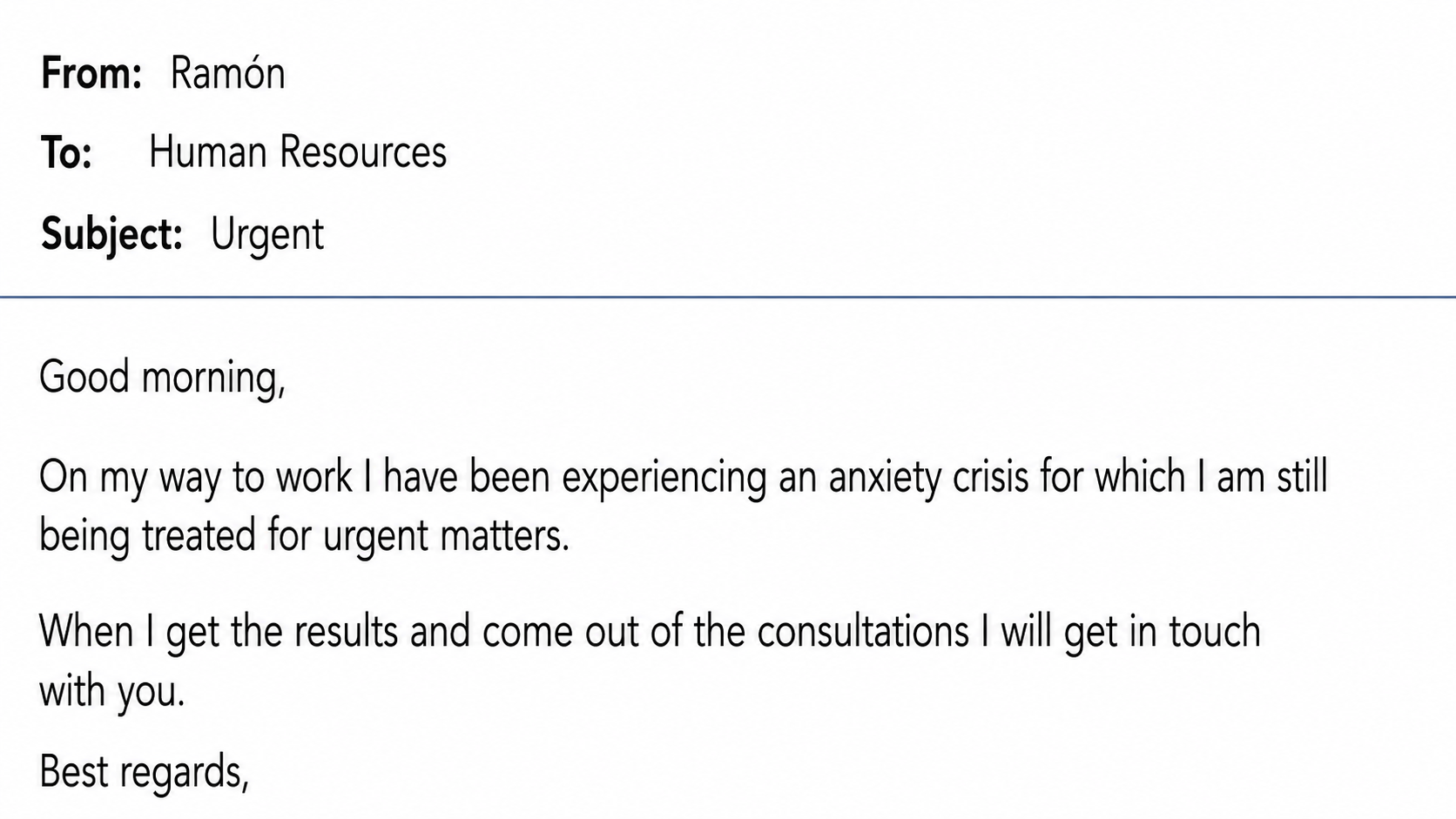
Notification of a health incident
Event type: absence notification.
Relevant fact: Ramón sends an email stating that he suffered a health incident on his way to work and is receiving medical attention. He says that he will make contact again when he has more information.
Evidentiary relevance: it establishes the reason for his absence on the day after the in-person meeting.
Associated evidence: email from Ramón.
Company response to the health incident
Event type: company response.
Relevant fact: the company replies to Ramón, accepts the situation, asks him to provide an update when he can, and prioritizes his recovery.
Evidentiary relevance: it maintains the previous pattern of a flexible response to reported health incidents.
Associated evidence: email from Antonio.
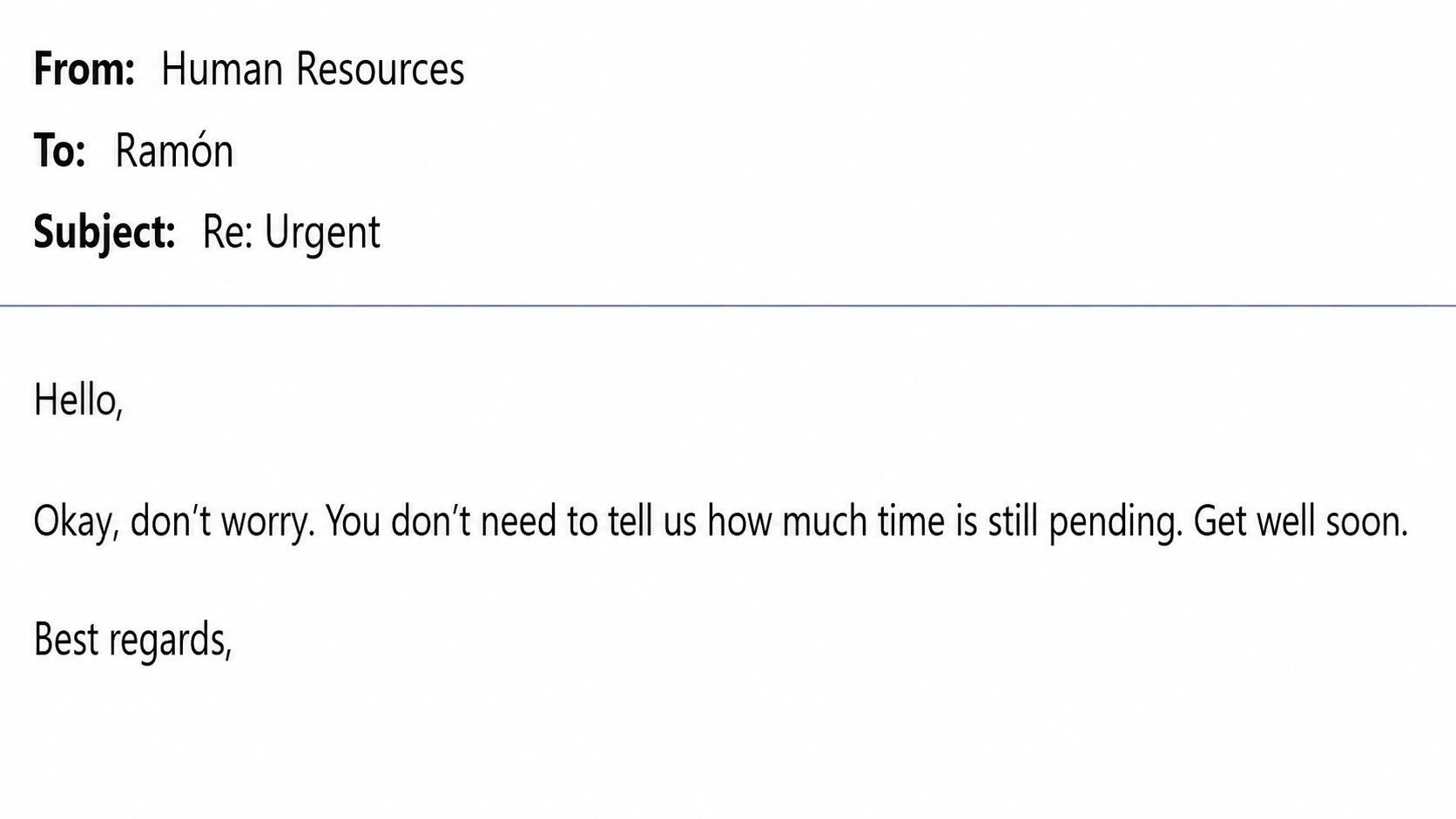
Ramón reports that he has been issued sick leave
Event type: communication regarding sick leave.
Relevant fact: Ramón later reports that, after receiving medical attention, he has been issued a sick-leave certificate that he understands will be communicated electronically to the company through the relevant administrative channel.
Evidentiary relevance: it introduces the question of whether the company receives the formal sick-leave notice through the ordinary channels.
Associated evidence: email from Ramón.
Disputed point: whether the company could act solely on Ramón's statement or had to wait for formal confirmation of the sick leave.
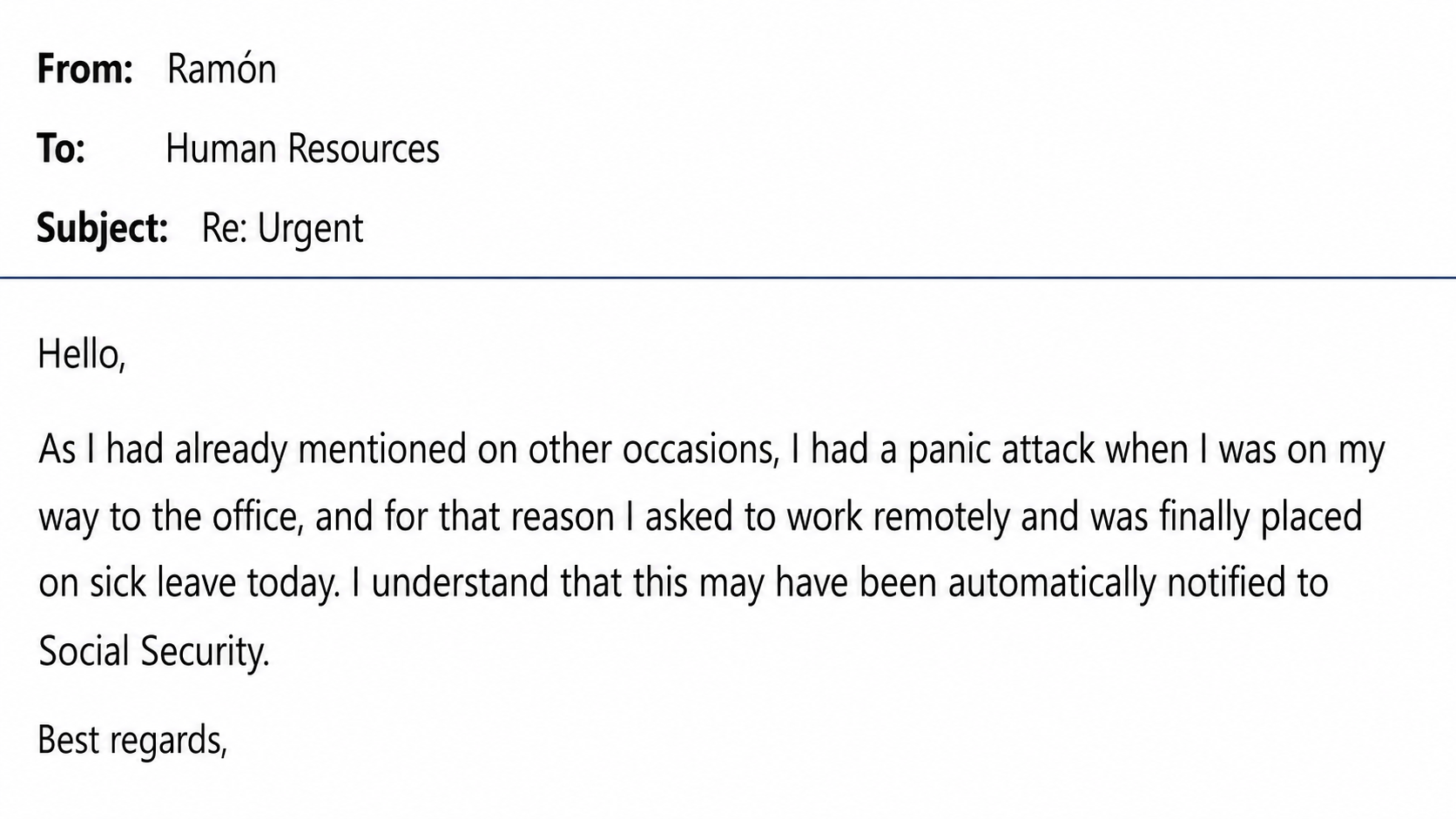
Inquiry with the advisory firm about receipt of the sick-leave notice
Event type: inquiry with the advisory firm.
Relevant fact: Antonio asks César whether any sick-leave notice for Ramón has been received. César confirms that no such notice has been received as of that time.
Evidentiary relevance: it explains why the company continues asking for information about Ramón's situation over the following days.
Associated evidence: communication with the advisory firm.
Request for an expected return-to-work date or confirmation of sick leave
Event type: written communication.
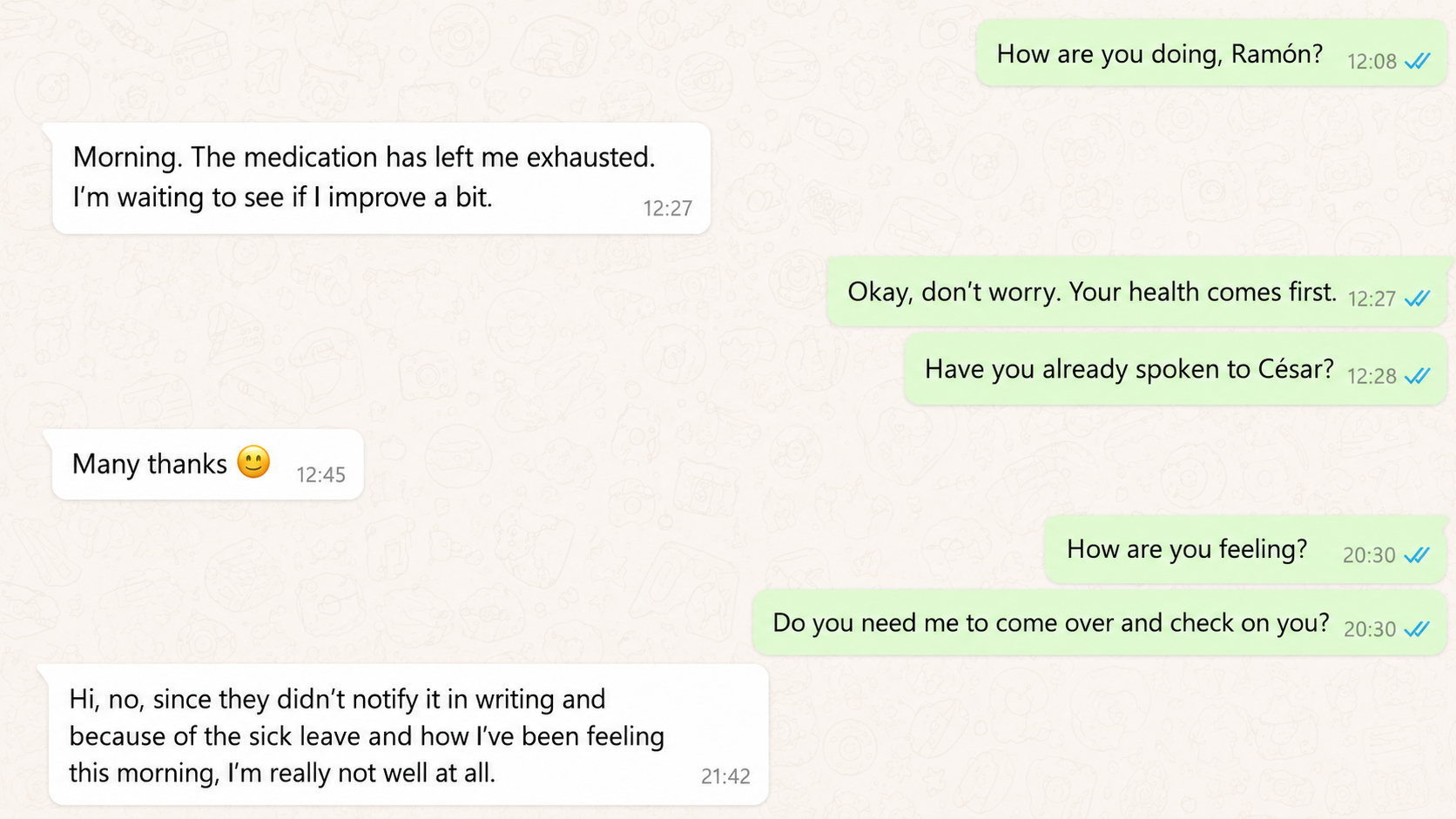
Relevant fact: the following day, the company has received no further information from Ramón and no formal sick-leave notice is on record. Antonio writes to ask about his condition and whether he will attend work, because it is necessary to organize the handover of tasks to Carolina.
Evidentiary relevance: it documents the operational need to plan the work during the notice period.
Associated evidence: WhatsApp screenshot.
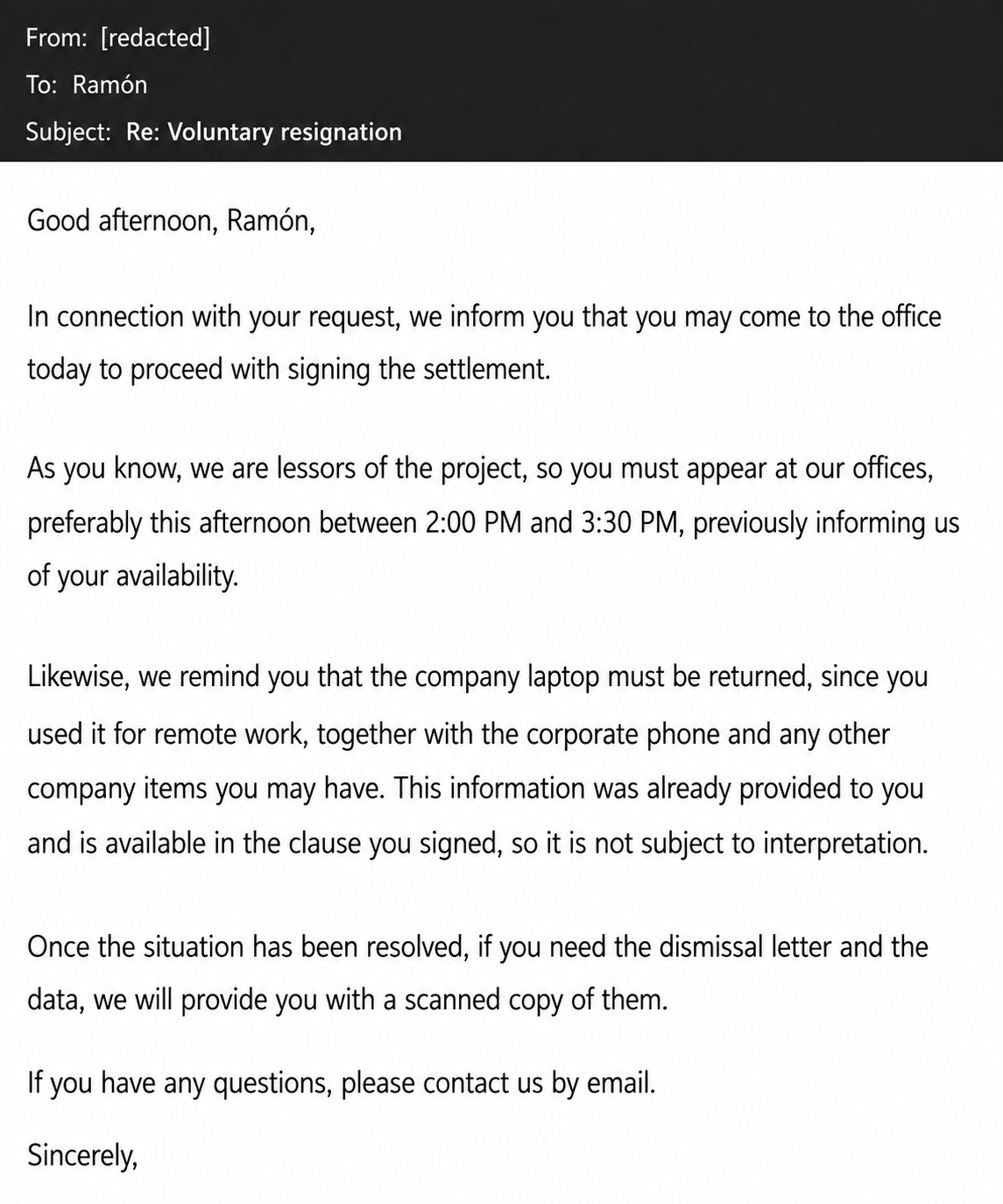
Request to attend for signing the final settlement and wiping the computer
Event type: documentary closure communication.
Relevant fact: the company writes to Ramón asking him to come to the office to sign the final settlement and bring the computer used for remote work. He is told that company software and sensitive information must be removed and that a document confirming the deletion must be provided.
Evidentiary relevance: it connects the closure of the employment relationship with the protection of corporate information and recovery of control over the equipment used remotely.
Associated evidence: email from Antonio.
Attendance at the office and disagreement over documentary closure
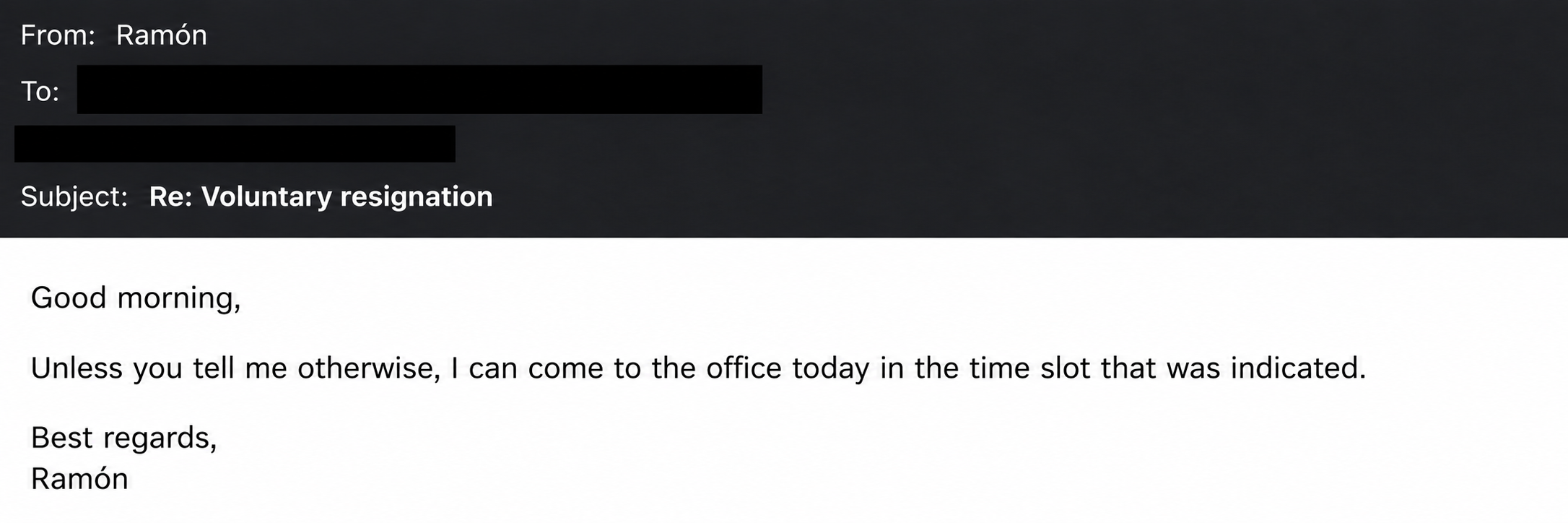
Ramón confirms by email that, unless something unforeseen occurs, he will attend the office during the time slot indicated by the company. His attendance is therefore coordinated in writing in order to close the outstanding documentation and review the equipment used for remote work.
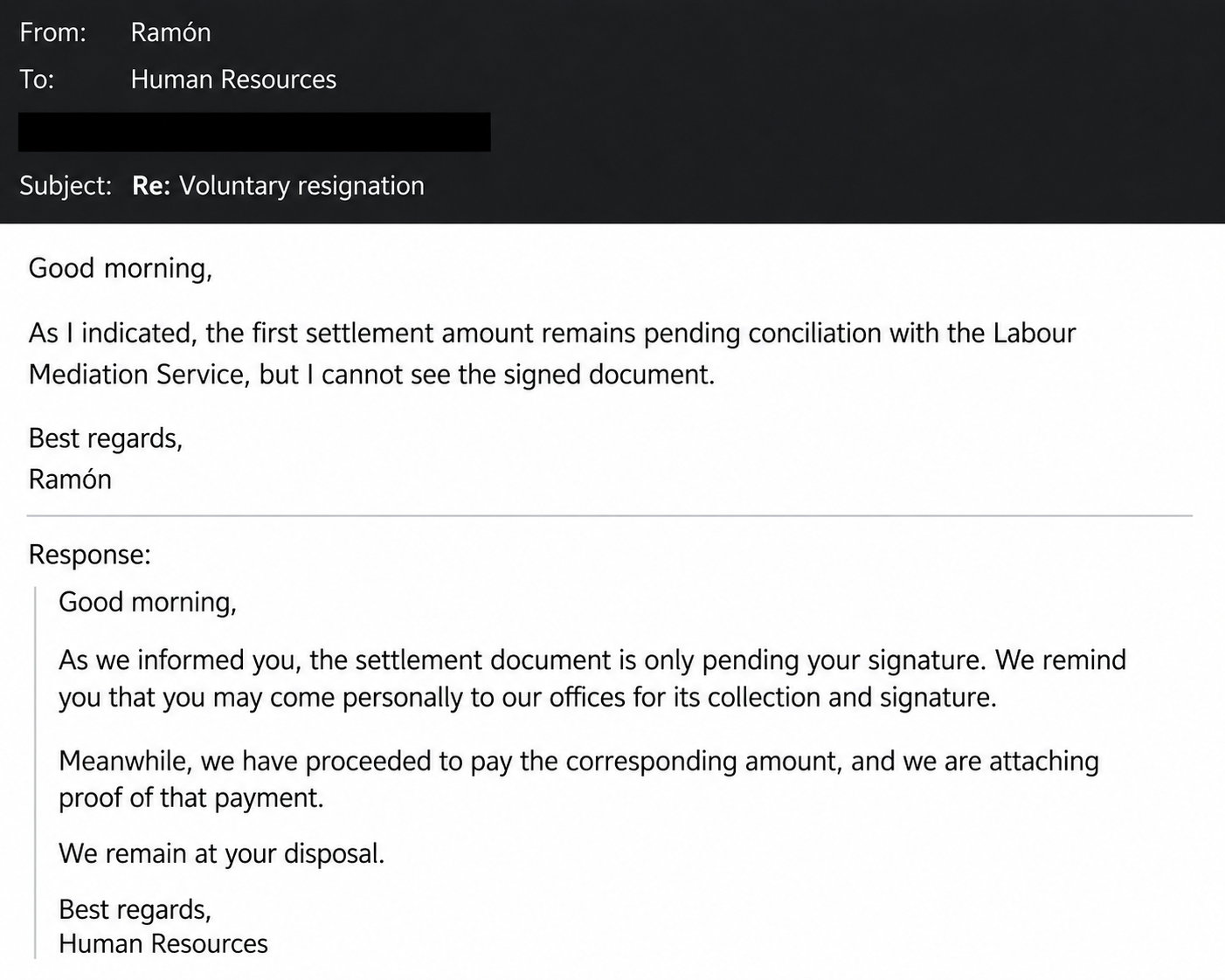
Ramón attends the office. The company deletes data from the computer used for remote work. Ramón does not sign the final-settlement document and records that it remains pending conciliation through an SMAC filing. The meeting marks the in-person closure of the employment relationship and his refusal to sign the final settlement at that time.
During the meeting, Ramón states verbally that the final three days of the contract, initially shown as unjustified absences in the settlement, were covered by sick leave. The company replies that it has received neither documentation nor an administrative notification allowing those days to be corrected. Ramón agrees to send it when he gets home. From that point, the financial closure depends on receiving formal confirmation of the sick leave so that the settlement can be adjusted.
Final settlement updated and request for delivery by email
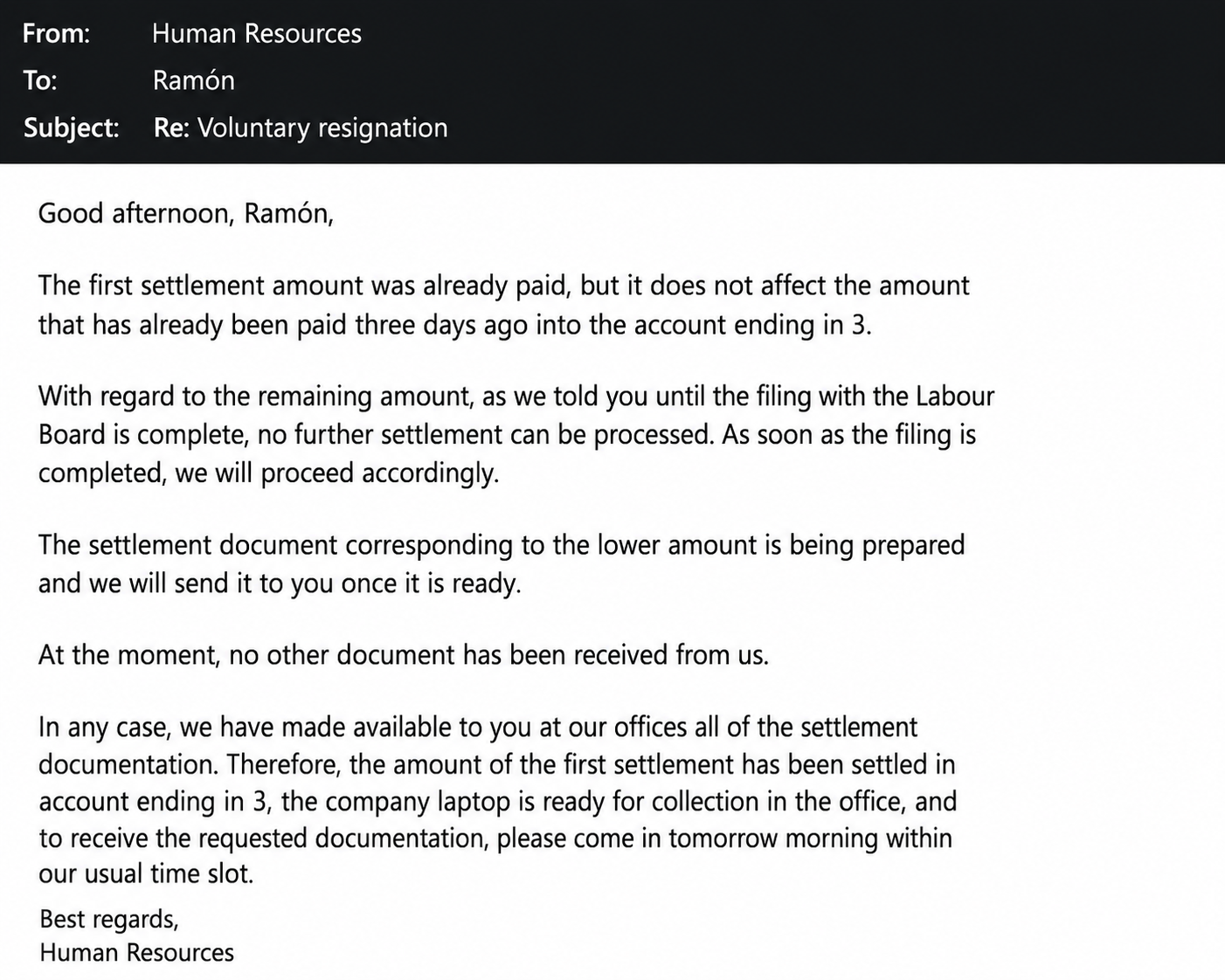
The company writes to Ramón stating that it has not received the documentation he had agreed to send after the in-person meeting. That same day, however, the administrative sick-leave notification arrives. Once it is received, the company amends the final settlement to include the three disputed days and offers Ramón the opportunity to attend and sign it.
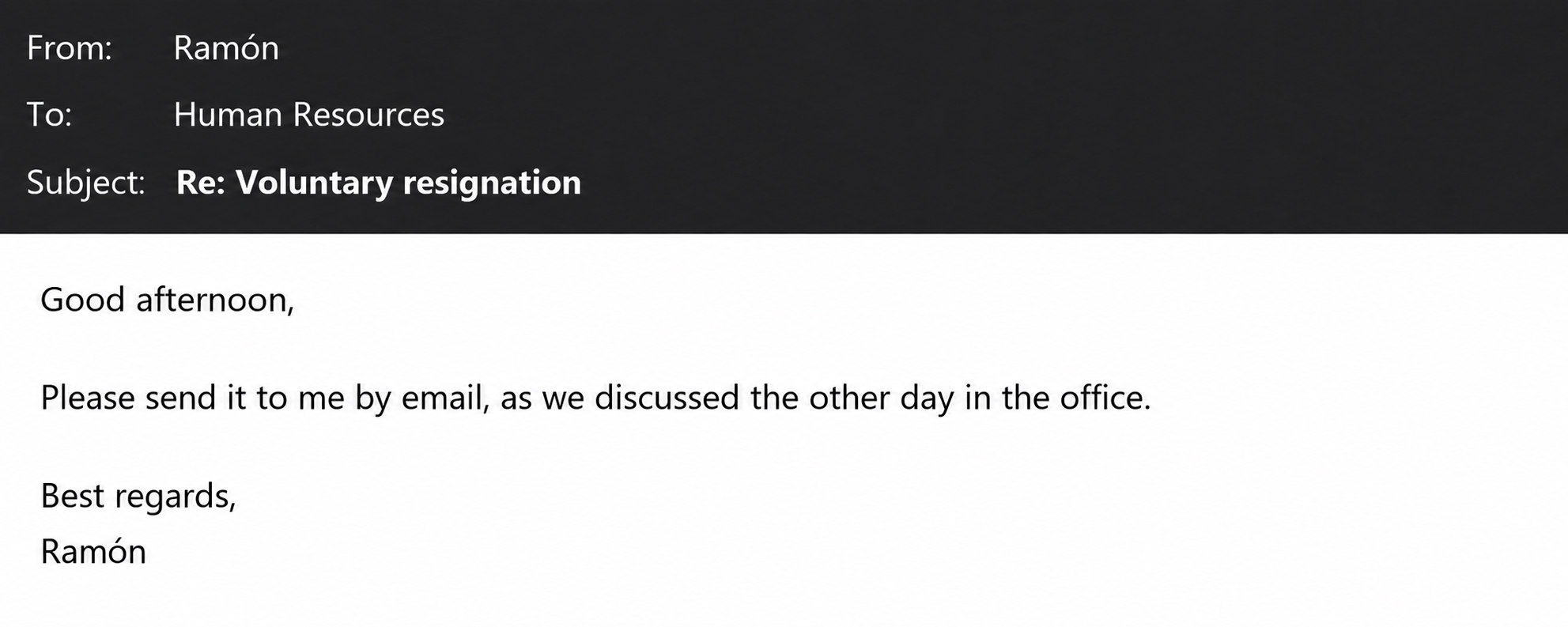
Ramón replies asking for the final settlement to be sent to him by email, as he says had been discussed in the office. Documentary closure therefore shifts from in-person signature to a request for electronic delivery, with the settlement already updated after formal confirmation of the sick leave was received.
Payment of the final settlement and continued absence of signature
Event type: payment and financial closure.
Relevant fact: the company tells Ramón that the final settlement is ready and awaiting signature, and that the corresponding amount has been paid. Ramón replies that he will not sign the document because the matter remains pending conciliation through an SMAC filing.
Evidentiary relevance: it closes the financial sequence: the absence of a signature does not prevent the company from paying the final-settlement amount.
Associated evidence: email from Antonio, Ramón's reply, and the bank payment confirmation referred to in the communication.